
Understanding LG Dryer Flow Sense Technology
Flow Sense is LG's built-in airflow monitoring system designed to detect restrictions in your dryer's ventilation system. This feature uses sensors to continuously monitor air pressure and flow within the exhaust ductwork. When the system detects reduced airflow—typically caused by lint buildup, kinks in the vent hose, or obstructions—the Flow Sense indicator illuminates on your dryer's display panel.
The system works by measuring static pressure inside the dryer drum and comparing it to expected airflow parameters. When readings fall outside normal ranges, the dryer triggers visual alerts or specific error codes (such as D80, D90, or D95) to notify you that airflow maintenance is required. This proactive monitoring prevents overheating, reduces fire risk, and maintains optimal drying efficiency.
Why Proper Airflow Matters for LG Dryers
Energy Efficiency and Drying Performance
Restricted airflow forces your LG dryer to work harder and longer to evaporate moisture from clothes. According to the U.S. Department of Energy, a clean dryer vent system can reduce drying times by up to 50% compared to a clogged system. When airflow is impeded:
- Energy consumption increases: The dryer draws power for extended cycles, raising utility costs
- Drying times double: Clothes that should dry in 40 minutes may take 80 or more minutes
- Heat distribution becomes uneven: Hot spots develop, potentially damaging fabrics or the heating element
Fire Safety Considerations
The National Fire Protection Association reports that clothes dryers account for approximately 15,000 home fires annually. Lint is highly combustible, and restricted airflow causes dangerous heat buildup. Flow Sense acts as an early warning system, alerting you to clean vents before temperatures reach hazardous levels. Regular maintenance significantly reduces these risks—properly maintained dryers operate at safer temperatures and vent hot gases efficiently away from the appliance.
Common Flow Sense Indicators and What They Mean
Visual Alerts
| Indicator | Meaning |
|---|---|
| Steady Flow Sense Light | Airflow restriction detected |
| Blinking Flow Sense Light | Severe airflow obstruction |
| "Check Filter" Message | Lint filter needs immediate cleaning |
Error Codes
When Flow Sense detects problems, LG dryers display specific diagnostic codes:
- D80: Approximately 80% blockage in the exhaust system
- D90: Severe airflow restriction (90%+ blockage)
- D95: Critical airflow failure requiring immediate attention
- CL Code: Door lock or vent system communication issue
Step-by-Step Troubleshooting for Flow Sense Issues
Immediate Actions When Flow Sense Activates
Clean the lint filter thoroughly: Remove all visible lint using your fingers or a soft brush. Even new filters can accumulate significant debris after heavy use.
Inspect the exhaust vent hose: Disconnect the flexible duct from the back of the dryer and check for kinks, crushing, or internal lint accumulation. Replace plastic or foil vents with rigid metal ducting.
Check the external vent cap: Ensure the outdoor vent opening isn't blocked by debris, bird nests, or weather damage. The flaps should open freely when the dryer operates.
Deep Cleaning Procedure
For persistent Flow Sense warnings:
- Turn off power: Unplug the dryer or switch off the circuit breaker
- Disconnect the entire vent system: Remove both ends of the exhaust duct
- Use a dryer vent brush: Feed the brush through the duct from both ends until resistance stops
- Vacuum loose debris: Use a shop vacuum to remove dislodged lint from the dryer's internal housing
- Reassemble and test: Reconnect all components and run a test cycle
Flow Sense Testing Procedures
Built-in Diagnostic Features
LG dryers include self-diagnostic capabilities accessible through the control panel:
- Access diagnostics: Press and hold "More" and "Wrinkle Release" buttons simultaneously for 5 seconds
- Enter test mode: The display will show "tESt" indicating diagnostic mode is active
- Check sensor readings: Navigate through test options to view real-time airflow measurements
- Exit test mode: Press "Cancel" or "Power" button to return to normal operation
Manual Airflow Verification
A practical test any homeowner can perform:
- Hold a tissue against the external vent opening while the dryer runs
- The tissue should be firmly sucked against the vent if airflow is adequate
- Weak suction indicates restriction requiring further investigation
- Listen for unusual noises—rattling may indicate loose ductwork or internal component issues
Maintenance Schedule for Optimal Flow Sense Performance
Weekly Tasks
- Clean the lint filter after every load
- Wipe down the filter housing to remove residual dust
- Check that the external vent flap moves freely
Monthly Inspections
- Inspect the exhaust duct for visible damage or crushing
- Vacuum accessible portions of the vent system
- Verify the exterior vent cap isn't accumulating debris
Annual Professional Service
Consider scheduling annual vent cleaning with a certified technician, especially if you frequently dry heavy items like comforters or pet bedding. Professional cleaning removes deep-seated lint that DIY methods often miss.
When to Call a Professional Technician
Flow Sense issues persisting after thorough cleaning typically indicate mechanical problems requiring expert attention:
- Blower motor failure: Results in no airflow regardless of vent condition
- Ductwork damage: Crushed or disconnected internal ducting within the dryer cabinet
- Sensor malfunction: Faulty pressure sensors providing inaccurate readings
- Control board issues: Electrical failures preventing proper sensor communication
For complex repairs involving internal components, contact LG-certified technicians or experienced appliance repair professionals. Attempting internal repairs without proper tools and knowledge can void warranties and create additional safety hazards.
Related Error Codes and Troubleshooting Guides
LG dryers use various codes beyond Flow Sense alerts. For comprehensive error code interpretation and LG dryer troubleshooting solutions, consult our detailed guide covering all common diagnostic indicators. Understanding codes like CL code issues and D80 blockage detection helps identify whether problems stem from airflow restrictions or other mechanical failures.
Frequently Asked Questions
### Can Flow Sense be temporarily disabled?
Flow Sense cannot be permanently disabled as it's a critical safety feature. However, running timed-dry cycles instead of sensor-dry cycles bypasses the airflow monitoring for that specific load. This workaround should only be temporary—addressing underlying airflow issues remains essential for safe operation.
### Does Flow Sense affect dryer warranty coverage?
Most LG dryer warranties remain valid regardless of Flow Sense activation. However, ignoring repeated warnings and allowing restricted airflow to cause component damage may result in denied claims for related repairs. Document maintenance efforts and address issues promptly to maintain warranty protection.
### How often should I clean my dryer vent?
Professional vent cleaning is recommended annually, though households doing 5+ loads weekly should consider bi-annual service. DIY cleaning of the lint filter should occur after every load, with monthly inspections of the exhaust ductwork and exterior vent cap.
### Why does Flow Sense activate immediately after cleaning?
If Flow Sense warnings persist after thorough cleaning, check for hidden restrictions: kinked ducting behind the dryer, improperly sealed joints allowing air leakage, or internal blower wheel obstructions. Some newer models require a manual reset sequence—typically turning the dryer off, waiting 10 minutes, then restarting.
### What's the difference between Flow Sense and Check Filter alerts?
The "Check Filter" message specifically indicates lint filter maintenance is needed. Flow Sense refers to broader airflow monitoring throughout the entire ventilation system, including ductwork, external vents, and internal blower components. Both systems work together to maintain optimal dryer performance and safety.
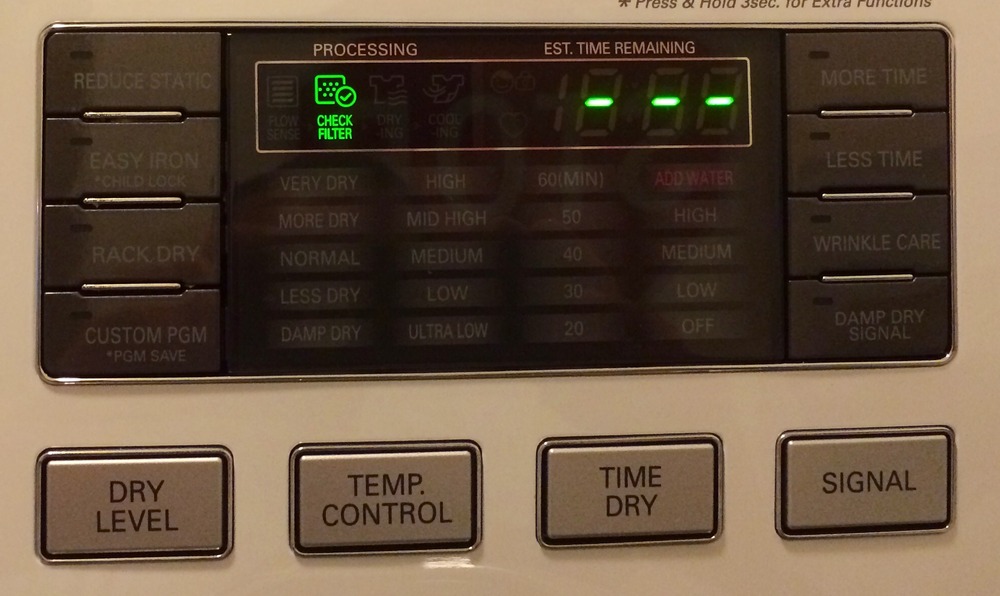
LG dryer control panel showing Flow Sense indicator and diagnostic codes
Image source: www.automaticwasher.org
Conclusion
Flow Sense represents LG's commitment to dryer safety and efficiency through intelligent airflow monitoring. By understanding how this system works and responding appropriately to alerts, you protect your investment while maintaining optimal drying performance. Regular maintenance—including weekly lint filter cleaning, monthly vent inspections, and annual professional service—keeps Flow Sense from becoming a persistent nuisance. Remember that ignoring Flow Sense warnings not only reduces drying efficiency but also creates serious fire hazards. When problems persist despite proper cleaning, don't hesitate to consult qualified technicians for diagnosis and repair.
This proactive approach ensures your LG dryer operates safely, efficiently, and reliably for years to come, providing the consistent performance you depend on for everyday laundry tasks. For additional insights into LG dryer error codes and comprehensive dryer diagnostic information, explore our extensive library of appliance troubleshooting resources.
Flow Sense vs. Traditional Dryer Monitoring Systems
Unlike older dryers that rely solely on timed cycles or basic moisture sensors, Flow Sense employs advanced differential pressure sensing technology. Traditional systems typically monitor only internal drum temperature or moisture content, missing critical ventilation issues until they become severe. Flow Sense's continuous monitoring detects airflow changes as small as 10% restriction, providing early intervention opportunities before problems escalate to dangerous levels or cause permanent component damage.
This sophisticated approach contrasts with basic thermal cutoff switches found in conventional dryers, which simply shut down the appliance when temperatures exceed safe thresholds. While effective as emergency protection, thermal cutoffs cannot prevent the gradual efficiency loss caused by progressive vent clogging. Flow Sense proactively maintains system performance by addressing airflow issues before they impact drying effectiveness or create safety hazards.
Environmental Impact of Proper Flow Sense Maintenance
Maintaining optimal airflow through Flow Sense compliance directly contributes to environmental sustainability. The U.S. Department of Energy estimates that properly vented clothes dryers consume 2,000 to 4,000 kilowatt-hours annually—roughly equivalent to running a household refrigerator continuously. When airflow restrictions force extended drying cycles, energy consumption increases proportionally, adding unnecessary strain to electrical grids and increasing carbon emissions.
Additionally, inefficient drying transfers excess heat into homes during summer months, potentially increasing cooling costs. Clean vent systems expel hot, moist air efficiently, reducing indoor humidity levels and easing the burden on home air conditioning systems. This synergistic effect demonstrates how proper Flow Sense maintenance contributes to broader household energy optimization strategies.
Integration with Smart Home Technology
Modern LG dryers featuring Flow Sense integrate seamlessly with smart home ecosystems through Wi-Fi connectivity and mobile app control. The LG ThinQ app provides remote monitoring capabilities, sending smartphone notifications when Flow Sense detects issues even when you're away from home. This connectivity enables immediate response to airflow problems, preventing minor restrictions from developing into major blockages during extended absences.
Smart integration also facilitates predictive maintenance scheduling based on actual usage patterns rather than arbitrary time intervals. The system tracks consecutive loads, average drying times, and environmental conditions to recommend optimal cleaning schedules tailored to your specific laundry habits and household size.
Cost-Benefit Analysis of Flow Sense Compliance
Regular Flow Sense maintenance delivers measurable financial returns through reduced energy costs and extended appliance lifespan. Assuming average electricity rates of $0.15 per kilowatt-hour and typical dryer operation of 4 cycles per week, maintaining clean vent systems saves approximately $45 annually in energy costs. Over a standard 12-year dryer lifespan, these savings compound to roughly $540 in avoided utility expenses.
Furthermore, preventing premature component failure through consistent airflow maintenance avoids costly repairs averaging $200 to $600. Professional vent cleaning services typically cost $100 to $150 annually, representing less than half the annual energy savings generated by proper maintenance. This compelling economic argument makes Flow Sense compliance one of the most cost-effective appliance maintenance investments available to homeowners.
Seasonal Considerations for Flow Sense Performance
Weather conditions significantly impact Flow Sense functionality throughout different seasons. During winter months, freezing temperatures can cause moisture in exhaust ducts to condense and subsequently ice over, creating temporary airflow restrictions that trigger false positive Flow Sense alerts. Installing insulated vent covers and ensuring ductwork slopes downward toward exterior terminations prevents water accumulation and subsequent freezing.
Summer humidity presents opposite challenges, as increased ambient moisture reduces the temperature differential between internal dryer components and external air. This diminished thermal gradient can slow moisture evaporation rates, increasing cycle times and causing Flow Sense to register elevated humidity levels even when actual airflow remains adequate. Adjusting drying times seasonally and selecting appropriate moisture settings helps maintain optimal Flow Sense performance year-round.
Commercial Applications and High-Volume Usage
For multi-unit residential buildings, laundromats, and commercial facilities utilizing LG dryers, Flow Sense maintenance assumes even greater importance due to elevated usage frequency. Commercial-grade models often operate 12 to 16 hours daily, accelerating lint accumulation and requiring more frequent intervention protocols. Implementing scheduled maintenance programs aligned with Flow Sense alerts reduces downtime and prevents cascading failures across entire laundry facilities.
Building managers should establish tiered response protocols based on Flow Sense severity levels: first-stage warnings trigger routine cleaning procedures, while critical alerts initiate immediate shutdown protocols to prevent system-wide disruptions and potential liability exposure from fire safety violations.