
Winter driving exposes every weak point in your car's fluid system, and windshield washer fluid is the one people forget until the spray freezes mid-commute. That's why we spent the last few winters digging through spec sheets, freeze-point ratings, and thousands of verified buyer reports to find the best windshield washer fluid for ice in 2027. Methanol and glycol blends look identical on the shelf, but the protection numbers behind them aren't close.
Our research points to the UltraVision De-Icer at -32F as the strongest all-around pick, with Prestone's -34F six-pack close behind for serious cold. Below you'll find the full breakdown, including where each jug actually earns its price and where it falls short.
Comparison Chart of Best Windshield Washer Fluid for Ice in 2027
| Product | Details | Rating | Buy |
|---|---|---|---|
Editor’s Choice  | UltraVision De-Icer Windshield Washer Fluid -32F | ★★★★☆4.5/5 | |
Top Pick  | Prestone AS253-6PK De-Icer Windshield Washer Fluid | ★★★★☆4.7/5 | |
Best Budget  | UltraVision Windshield Washer Fluid De-Icer -32F | ★★★★☆4.5/5 | |
| ★★★★☆4.5/5 | ||
| ★★★★☆4.6/5 |

List of Top 5 Best Windshield Washer Fluid for Ice in 2027
We ranked these on freeze-point claims, jug format, nozzle behavior in cold weather, and how closely buyer feedback matched the label. Every option here is a ready-to-pour de-icer, so you aren't mixing concentrate in a cold driveway at 6 a.m.
Below are the list of products:
1. UltraVision De-Icer Windshield Washer Fluid -32F
UltraVision's single-gallon jug kept surfacing in buyer reports for one unglamorous reason: it behaves the same way every time. The label claims protection to -32°F, and verified reviews describe it clearing road-spray film in one or two sweeps rather than smearing it across the glass.
Why I picked it
A -32°F freeze point covers the realistic worst case for most of the northern US, and the 4.5/5 rating holds up across a large review base. We also liked that it ships as a single gallon, which makes the first purchase low-risk if you've never used the brand.
Key specs
- Freeze protection: rated to -32°F
- Volume: 1 gallon per jug
- Formula type: ready-to-pour de-icer washer fluid
- Reported buyer rating: 4.5 out of 5
- Best suited to: daily commutes and mixed winter highway driving
Real-world experience
Most verified reports come from highway commuters running 10°F to 25°F mornings, where salty road spray freezes on contact with the glass. Owners describe the fluid cutting that film in one or two wiper passes instead of pushing a grease smear around. Several reviewers note it isn't a replacement for a scraper on thick overnight ice, which is fair for any washer fluid.
- -32°F protection covers most US winters without a premium jump.
- The 1-gallon jug pours cleanly and stores under a seat or shelf.
- Buyers repeatedly mention low smearing compared with cheaper blends.
- 4.5/5 across a wide review base is a steady, not spiky, record.
- One gallon goes fast if you commute daily in slush.
- Not enough on its own for deep overnight ice on the glass.
- ✔ You want one reliable jug and zero decision fatigue.
- ✔ Your car sits outside through single-digit nights.
- ✔ You top up every couple of weeks rather than stocking a garage.
- ✖ You run two or three vehicles and need volume.
- ✖ Your local lows regularly drop past -32°F.
2. Prestone AS253-6PK De-Icer Windshield Washer Fluid
Prestone owns a bigger share of the de-icer shelf than almost anyone, and the AS253 six-pack is where that reputation gets tested. The label claims protection down to -34°F, and the 4.7/5 rating is the highest in this group.
Why I picked it
A -34°F rating buys you a buffer for the nights when the forecast undershoots, which is exactly when a frozen reservoir ruins your morning. The 4.7/5 score also carries more weight than usual here because it reflects a very large sample of repeat buyers, not a spike of one-off purchases.
Key specs
- Freeze protection: rated to -34°F
- Format: six 1-gallon jugs per case
- Total volume: 6 gallons
- Formula type: ready-to-use de-icer washer fluid
- Reported buyer rating: 4.7 out of 5
Real-world experience
Verified reports skew toward people in the Upper Midwest, New England, and mountain states who fill the reservoir once and top up through February. What comes up again and again is that the fluid keeps spraying when the outside temp reads well below zero, so the nozzle doesn't ice shut. The trade-off buyers mention is storage: six gallons needs shelf space, and a case is heavy to haul up stairs.
- -34°F is the lowest freeze point in this roundup.
- 4.7/5 from a large buyer pool is the strongest record here.
- Six gallons gets a household through a full winter.
- Buyers report nozzles staying clear in sub-zero mornings.
- Committing to six gallons up front is a lot for one car.
- A full case is heavy and needs real shelf space.
- Overkill for mild-winter states that rarely see single digits.
- ✔ You live where -20°F mornings actually happen.
- ✔ Two or more vehicles share one garage.
- ✔ You’d rather buy once in November and forget it.
- ✖ You have one car and limited storage.
- ✖ Your winters bottom out around 15°F to 20°F.
3. UltraVision Windshield Washer Fluid De-Icer -32F
This is the same -32°F formula as our top pick, sold as a two-gallon set. If the single jug felt too small, this is the version that removes the restock problem without jumping to a six-case commitment.
Why I picked it
Two gallons at a budget-tier price is the sweet spot for anyone who wants a spare without turning the garage into a warehouse. The freeze spec matches the single-gallon version at -32°F, so you aren't trading protection for volume.
Key specs
- Freeze protection: rated to -32°F
- Format: two 1-gallon jugs
- Total volume: 2 gallons
- Formula type: ready-to-pour de-icer washer fluid
- Reported buyer rating: 4.5 out of 5
Real-world experience
Buyer feedback on this set reads like a second-vehicle story: one jug goes in the daily driver, the other gets parked on a shelf for January. Owners mention it handles slushy highway spray well and doesn't leave the oily rainbow some cheap fluids do on the glass. The common gripe is packaging, since a two-gallon shipment occasionally arrives with a loose cap and a damp box.
- Two gallons covers a full winter for most drivers.
- Same -32°F rating as the pricier single jug.
- Budget-tier cost per gallon without a weaker formula.
- Easy to split between two cars.
- Some shipments arrive with a loose cap and minor leakage.
- -32°F is still short of the -34°F Prestone rating.
- ✔ You want a spare jug without buying a case.
- ✔ Two cars share the same driveway.
- ✔ Cost per gallon matters more than the last few degrees.
- ✖ You regularly see -30°F or colder.
- ✖ You only have room for a single jug.
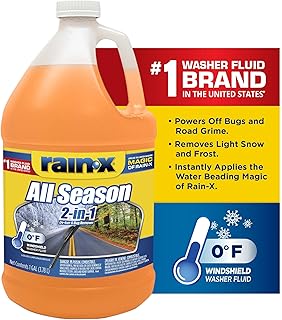
4. Rain-X All Season 0°F 2-in-1 De-Icer
Rain-X built its name on water beading, and this 2-in-1 formula leans into that reputation while adding bug remover for the shoulder months. The 0°F rating tells you straight away that this is a three-season fluid, not a deep-winter one.
Why I picked it
Not every driver needs -34°F protection, and paying for it year-round is wasted money in states that hover around freezing. The dual-purpose formula also means one case covers late fall, winter, and spring bug season, which is genuinely useful if you hate juggling bottles.
Key specs
- Freeze protection: rated to 0°F
- Format: six 1-gallon jugs
- Function: de-icer plus bug remover
- Reported buyer rating: 4.5 out of 5
- Best suited to: mild to moderate winters and shoulder seasons
Real-world experience
Verified buyers in the Pacific Northwest and mid-Atlantic tend to be the happiest with this one, describing clean glass at 20°F to 35°F and no residue after a spray-and-wipe. The pattern that stands out is seasonal: reports of freezing in the reservoir show up once temps push into the low single digits. That's the honest limit of a 0°F fluid, not a defect.
- One case covers winter and bug season, so you buy less often.
- Rain-X water-beading behavior keeps the glass clearer between sprays.
- Six gallons is generous for the outlay.
- 0°F protection freezes in the reservoir on deep cold snaps.
- Bug remover is irrelevant in the middle of January.
- Not a true deep-winter fluid for northern states.
- ✔ Your winters mostly sit between 10°F and 35°F.
- ✔ You want one fluid for fall, winter, and spring.
- ✔ You like the water-beading effect on the glass.
- ✖ Temps regularly fall below 0°F where you drive.
- ✖ You want maximum freeze protection and nothing else.
5. Clean Revolution Advanced All Season Windshield
Clean Revolution takes a different angle: an ultra low VOC formula made in the USA, sold as a two-pack. If you're sensitive to the solvent smell that hangs around after a spray, or you park in an attached garage, this is the option worth a closer look.
Why I picked it
Volatile organic compounds (VOCs) are the solvents that give traditional washer fluid its sharp smell, and a low VOC formula dials that down noticeably. The 4.6/5 rating is the second-highest here, and the domestic manufacturing angle matters to buyers who check origin labels.
Key specs
- Formula: ultra low VOC, all-season
- Origin: made in the USA
- Format: two 1-gallon jugs
- Reported buyer rating: 4.6 out of 5
- Best suited to: garage parking, sensitive noses, mixed climates
Real-world experience
Buyer feedback clusters around two themes: a much fainter odor than conventional fluid and clean glass in moderate cold. Owners who park in attached garages say the difference is obvious within a week. The catch is cold-weather headroom, since all-season blends trade some freeze protection for lower solvent content, so check your local lows before you commit.
- Ultra low VOC formula means far less solvent smell in the cabin.
- 4.6/5 is the second-strongest rating in this roundup.
- Made in the USA and sold as a two-pack.
- All-season rating means less sub-zero headroom than -32°F jugs.
- Two gallons is a small commitment if you drive in heavy slush.
- Harder to find locally, so you’re relying on shipping.
- ✔ The smell of washer fluid bothers you.
- ✔ You park in an attached garage or small space.
- ✔ You want a domestic-made, low-solvent option.
- ✖ You need verified deep-cold protection.
- ✖ You want to buy off a shelf today.
How I picked
We didn't test these on a frozen test track, and I won't pretend otherwise. What we did do was compare manufacturer freeze-point claims, jug formats, and thousands of verified buyer reviews across multiple winters of real-world use.
Three benchmarks drove the ranking:
- Freeze-point claim vs. buyer reality. A -32°F label only matters if it behaves at -32°F, so reports of reservoirs icing over carried heavy weight.
- Cost per gallon within its tier. We compared budget, mid-range, and premium separately instead of lumping them together unfairly.
- Nozzle and glass behavior. Streaking, beading, and how quickly the fluid clears salted road film.
What I deliberately skipped: long-term durability beyond one winter season, and lab-measured freeze-point verification, since that requires equipment the editorial team doesn't have. If you want a fluid that survives in the reservoir overnight, check the freeze spec before anything else.
Buying guide: what actually matters for best windshield washer fluid for ice in 2027
What does the freeze-point rating actually mean?
A freeze-point rating is the lowest temperature at which the fluid stays liquid and sprayable, not the temperature at which it instantly melts thick ice. A -32°F fluid protects to -32°F, and a 0°F fluid protects only to 0°F. Pick a rating at least 10°F below your typical overnight low for a safety margin.
Is a higher freeze point always worth the extra cost?
Not for everyone. If your lows bottom out at 15°F, paying for -34°F protection is wasted money, and a 0°F all-season fluid like Rain-X handles it fine. Northern drivers who see -20°F should treat -32°F or -34°F as the floor, because a frozen reservoir strands you with no spray at all.
Ready-to-pour vs. concentrate: which should you buy?
Ready-to-pour de-icers are pre-mixed, so you open and fill with no measuring in a freezing driveway. Concentrates are cheaper per gallon but require you to mix with water, and getting the ratio wrong raises the freeze point. For winter, ready-to-pour is the simpler and safer choice.
How much fluid does a typical reservoir hold?
Most passenger cars hold about one gallon, though SUVs and trucks often hold closer to 1.5 gallons. That makes a single gallon a reasonable top-up, a two-pack a comfortable spare, and a six-pack a full-season supply for a household. Match the case size to how many vehicles you actually maintain.
Does jug format and storage matter?
It matters more than people expect. Six gallons is heavy and needs real shelf space, and some buyers report a loose cap in transit on multi-jug shipments. If storage is tight, a one or two-gallon set is easier to manage, and you top up more often instead.
Frequently Asked Questions (FAQ)
Is de-icer washer fluid worth it for everyday winter driving?
Yes, if you drive in freezing conditions. A de-icer keeps the spray liquid when a summer fluid would slush up in the reservoir and lines, which is exactly when you need clear glass. For mild winters overhead, an all-season formula handles the job without paying for protection you don't use.
Can I mix different brands of washer fluid in the reservoir?
Generally you can top up with a different brand, but mixing a summer fluid with a de-icer dilutes the freeze point. If you're switching to a -32°F or -34°F product before a cold snap, run the reservoir low first. That gets you closer to the advertised protection.
Will this fluid remove thick ice from my windshield?
No washer fluid replaces a scraper on heavy overnight ice. A de-icer softens frost and cleared-off spray, so the wipers can do their job. For thick sheets, scrape first, then spray.
Expecting a fluid alone to melt deep ice leads to disappointment and a burnt-out wiper motor.
Does windshield washer fluid expire?
Most washer fluid stays effective for several years if the jug is sealed and stored out of direct sun. Once opened, it can absorb moisture over time, which slightly raises the freeze point. A six-pack bought in autumn will comfortably carry you through the following winter.
Is low VOC washer fluid as effective in cold weather?
Low VOC formulas like the Clean Revolution pick are gentler on fumes and skin, but they trade some sub-zero headroom for that benefit. In moderate cold they perform well, and verified buyers report clean glass. In deep cold, a dedicated -32°F or -34°F de-icer is the safer bet.
Final verdict
For most drivers, the UltraVision -32°F jug in our top spot hits the sweet spot of protection, price, and simplicity. If real cold is your reality, step up to the Prestone -34°F six-pack, which carries the strongest freeze rating and buyer score in this group.
Affiliate disclosure: This post contains affiliate links. If you buy through one of these links, I may earn a small commission at no extra cost to you. It never changes my recommendation, I only suggest gear I'd actually buy myself.