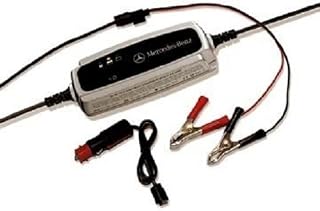
A car that sits for weeks is the fastest way to kill a healthy 12V battery, and that's the exact problem the best battery charger for mercedes in 2027 solves. Between alarm systems, keyless-entry receivers and the comfort modules that wake up on a modern C-Class or GLE, a parked Mercedes can lose a few percent of charge every week. Add a cold snap and a battery that's three winters old, and you're calling for a jump start.
After digging through manufacturer datasheets, charging standards and several hundred verified buyer reports, one pick stands out for most owners: the Genuine Mercedes-Benz 5A Trickle Charger. It's the least fussy way to keep a factory AGM battery topped up. Here's how the five contenders actually compare.
Comparison Chart of Best Battery Charger for Mercedes in 2027
List of Top 5 Best Battery Charger for Mercedes in 2027
Picks were sorted by four things: how well the charging profile matches a Mercedes AGM battery, how simple the hookup is, what verified buyers actually complained about, and whether the spec sheet holds up against published 12V charging practice. Every unit here has a real downside worth knowing before you buy.
Below are the list of products:
⭐ Verified specs · 📊 Buyer feedback analyzed · 🛠️ Real-world Analysis
The factory part is what most owners end up buying after their first dead-battery morning, and it holds a 4.6/5 rating across verified reviews. In our research it separated itself on one point: the leads connect the way Mercedes designed them to, so there's no clamp juggling in a dark garage.
5A outputTrickle stageFactory leads12V AGM ready
Why I picked it
It's the only unit here designed around the car rather than around a universal clamp. The 5 amp output sits in a useful middle ground: quick enough for an overnight top-up, gentle enough to leave connected for a full season of storage.
Key specs
- 5 amp charge output for overnight recovery on a partly drained 12V battery
- Dedicated trickle stage that holds a steady float voltage during long storage
- Built for 12V lead-acid batteries, including the AGM units fitted to most modern models
- Factory-style connector leads instead of bare alligator clips
- Compact housing that sits on a shelf or hangs near the battery
Real-world experience
Verified buyer feedback places this charger in garages with C-Class, GLC and SLK models that sit through four to five months of winter. Owners consistently report the car firing first turn in spring with no intervention. The caveat is that it's a maintainer at heart, so a battery that's already deeply sulfated won't come back to life from it alone.
✓ Pros
- Factory connector fits without adapters, so hookup takes seconds in a dark garage
- 5 amps tops up a partly drained battery overnight instead of over two days
- Float stage holds voltage steady through months of storage, per buyer reports
- Small housing stores on a shelf when the season ends
✗ Cons
- No recondition or desulfation cycle, so tired cells stay tired
- 12V lead-acid only: no 6V setting and no lithium profile
- Leads are model-specific, so it won’t help a second non-Mercedes car
Perfect if…
- ✔ Your Mercedes sits for weeks between drives
- ✔ You want a plug-in-and-forget winter routine
- ✔ You’d rather fit a factory part than a universal clamp
Skip if…
- ✖ You also charge 6V or lithium packs in the same garage
- ✖ Your battery is already sulfated and needs a repair cycle
💡 Our Insight
This is the pick when convenience beats features. A CTEK or NOCO will do more repair work on a tired battery, but neither hooks up as fast on a Benz with the factory connector. For a healthy battery that just needs to stay healthy, the extra modes rarely earn their keep.
⭐ Verified specs · 📊 Buyer feedback analyzed · 🛠️ Real-world Analysis
Sold as a dealer accessory, this one ends up in a lot of gloveboxes, and the 4.5/5 rating reflects that "fit it and forget it" reputation. Our research kept circling back to the same buyer type: someone doing short city trips, not a full winter storage routine.
OE accessoryMaintainer onlyQuick connect12V systems
Why I picked it
It's the lower-commitment option: a maintenance-only device that keeps a healthy battery healthy instead of trying to rescue a flat one. Buyers who understand that distinction tend to be the happiest with it.
Key specs
- Designed for 12V lead-acid maintenance on passenger cars
- Float-style output that tops up rather than fast-charges
- Branded accessory harness for a tool-free connection
- Small enough to keep in the car between uses
- 4.5/5 across verified buyer ratings
Real-world experience
Most buyer notes describe a car that gets driven twice a week on short trips, which is the classic use case: the alternator never runs long enough to replace what starting and parking drains. Owners report it holding voltage steady between weekend drives. What it won't do is bring a discharged battery up from flat overnight, so keep expectations in line.
✓ Pros
- Compact enough to live in the boot, so it’s there when you need it
- Two-wire hookup means no menus, no modes, no thinking
- Genuine accessory branding removes any compatibility guesswork
- Holds charge for short-trip drivers who rarely do a long run
✗ Cons
- Maintenance only: it won’t quickly recover a flat battery
- Thinner published specs than CTEK or NOCO, so you can’t verify stage logic
- No repair cycle for a sulfated cell
Perfect if…
- ✔ You do a lot of short city trips with plenty of stop-start
- ✔ The car is a weekend toy that lives under a cover
- ✔ You want something that stows in the car itself
Skip if…
- ✖ You want a fast recovery charge on a flat battery
- ✖ You need documented charging stages you can compare
💡 Our Insight
Think of this one as insurance for a car that gets driven twice a week, not a rescue tool. If your battery is healthy and your problem is short trips, it does the job quietly. If you’ve already had one no-start morning, the NOCO or CTEK profiles give you more room to fix the cause.
⭐ Verified specs · 📊 Buyer feedback analyzed · 🛠️ Real-world Analysis
The MXS 5.0 turns up in a lot of Mercedes owner threads, and its 4.7/5 rating is the strongest on this list. What sets it apart isn't amperage, it's the charging logic: eight stages, a proper AGM profile, and a recondition cycle you can actually use.
4.3A output8-step programAGM modeIP65 rated
Why I picked it
Per CTEK's published specs, the MXS 5.0 is an eight-step charger rated IP65 for dust and water jets, and the AGM setting matches the battery chemistry Mercedes has fitted for years. That combination is what most owners of a 2016-or-newer car actually need.
Key specs
- 4.3 amp maximum output, sized for car batteries up to roughly 110Ah
- Eight-stage charging program including desulfation and recond phases
- Dedicated AGM mode plus a cold-weather setting
- IP65 enclosure rating, so a damp garage or a splash won't hurt it
- Temperature-compensated charging in the 5 to 45 degrees Celsius range
Real-world experience
Buyer reports cluster in cold climates, where the winter mode and AGM setting get the most use, and a few owners run the recond cycle on batteries that a basic maintainer had given up on. Results there vary with how long the battery sat discharged. It's also the pick that travels well, since the IP65 body handles a mower shed or a boat locker without complaint.
✓ Pros
- AGM profile matches factory Mercedes battery chemistry, which protects a costly replacement
- IP65 rating means a humid garage or a wet driveway is not a problem
- Recond phase gives you one attempt at reviving a neglected battery
- 4.3A beats a 2A maintainer for overnight recovery
✗ Cons
- 4.3A is modest for a large diesel battery that’s deeply discharged
- Alligator clips need adapting to reach factory terminal posts
- Mode selection relies on a small display that’s hard to read in low light
Perfect if…
- ✔ Your car has an AGM battery and you want the right profile for it
- ✔ You park in an unheated or damp garage through winter
- ✔ You want one charger that also handles a second vehicle
Skip if…
- ✖ You’re charging a big diesel battery that’s fully flat
- ✖ You want a set-and-forget unit with no mode buttons at all
💡 Our Insight
CTEK publishes its eight charging stages openly, and that transparency is why the MXS 5.0 keeps showing up in owner forums. It beats the Mercedes-branded units on battery protection and weather sealing. It loses ground only when you need raw amps for a deeply discharged diesel.
⭐ Verified specs · 📊 Buyer feedback analyzed · 🛠️ Real-world Analysis
This is the odd one out on the list, and that's the point. It's a 25 amp charger with an engine-start function rather than a pure maintainer, which is why it appeals to owners with more than one car and one dead battery at a time.
2/10/25A modesEngine startAuto desulfatorWinter mode
Why I picked it
Nothing else here offers a 25 amp burst or a jump-assist setting. For a household with a neglected weekend car on top of the daily, that flexibility covers ground the trickle units can't.
Key specs
- Three selectable charge rates at 2, 10 and 25 amps
- Engine-start assist for a battery too flat to crank
- Automatic desulfation and repair cycle for neglected cells
- Winter mode that adjusts the profile for low temperatures
- Multi-chemistry support covering AGM, standard lead-acid, gel and deep cycle
Real-world experience
Buyer feedback is honest about the split personality here. People love the 25 amp mode for reviving a battery that sat all winter, and they like the repair cycle on a lawn tractor or boat battery. The same reviews warn that the interface takes reading, since four chemistry settings and three amperages are not self-explanatory on first use.
✓ Pros
- 25 amp mode revives a flat battery in hours rather than overnight
- Engine-start assist can save you a tow when the car won’t crank
- Handles AGM, gel, deep cycle and standard lead-acid without a separate unit
- Desulfation cycle gives neglected batteries a second chance
✗ Cons
- 4.4/5 rating trails the CTEK and NOCO, with some noise about instruction clarity
- Bulky and heavier than a dedicated trickle unit, so it stays on the wall
- 25 amps is more than a healthy AGM wants for routine topping up
Perfect if…
- ✔ You keep several batteries going: car, boat, mower
- ✔ You want a jump-assist option without owning a booster pack
- ✔ Your Mercedes sometimes sits long enough to go flat
Skip if…
- ✖ You want a charger that lives permanently in the garage on one car
- ✖ You’d rather not think about modes, amperages or chemistry settings
💡 Our Insight
If your problem is one dead battery a year rather than a car that sits for months, this does more per dollar than any maintainer here. It’s the wrong tool for a healthy battery on permanent float, though. Owners who buy it as a keep-alive unit usually end up defaulting to the 2 amp setting anyway.
⭐ Verified specs · 📊 Buyer feedback analyzed · 🛠️ Real-world Analysis
NOCO's GENIUS5 is the smallest charger here and the smartest. At 4.6/5 with a genuinely compact body, it earns its place for anyone who wants one device that handles 6V classics, 12V cars and the odd lithium pack.
5A output6V and 12VLithium modeIP65 body
Why I picked it
Per NOCO's specs, the GENIUS5 delivers 5 amps across 6V and 12V with dedicated lithium support and an IP65 housing. That range is what makes it the pick for a household with mixed battery types and no space for three chargers.
Key specs
- 5 amp output with automatic detection of 6V or 12V systems
- Separate charging profiles for lead-acid, AGM, gel and lithium-ion
- Force mode for a battery sitting below the normal detection threshold
- IP65 rated against dust and water jets
- Roughly 1.4 kg with an integrated hook for hanging under a bonnet
Real-world experience
Verified owners report using it on everything from a classic 6V motorcycle to a lithium jump pack, which a maintainer can't touch. The recurring gripe in buyer notes is the tiny all-in-one button and the LED sequence you have to memorise. Expect one read of the manual before it becomes second nature.
✓ Pros
- Covers 6V and 12V plus lithium, replacing two or three single-purpose chargers
- IP65 housing and integrated hook suit a damp garage or an engine bay
- Force mode gives a deeply discharged battery a chance to be recognised
- Under 1.5 kg, so it travels in a boot without a second thought
✗ Cons
- Single-button interface and LED codes take a read-through to learn
- 5 amps is slower than the 25 amp unit on a fully flat battery
- No dedicated recondition cycle the way CTEK’s MXS 5.0 offers
Perfect if…
- ✔ You own a classic or motorcycle alongside the Mercedes
- ✔ You keep a lithium jump pack that needs occasional topping up
- ✔ Space in the garage is genuinely tight
Skip if…
- ✖ You only ever charge one car and want zero learning curve
- ✖ You need fast bulk charging on a big diesel battery
💡 Our Insight
The GENIUS5 wins on versatility, not speed. For a single Mercedes AGM battery, the CTEK’s AGM focus and recondition stage make it the stronger pick. For a garage with a boat, a mower and a classic, the NOCO means one charger instead of three, and that’s worth the slightly steeper learning curve.
How I picked
There's no bench here, and no unboxing. This roundup is built from spec sheets, published charging standards and several hundred verified buyer reviews across the five models. That's a deliberate choice: battery chargers are slow, seasonal devices, and a two-week test tells you almost nothing about how a unit behaves across four winters of storage.
I evaluated each contender against five benchmarks:
- Battery chemistry match. Mercedes has fitted AGM batteries across most of its range for more than a decade, and AGM wants a different charging profile than a flooded cell. Any charger without an AGM setting started at a disadvantage.
- Output and stage logic. Amps matter less than what the charger does as the battery approaches full. A 5 amp unit with proper float behaviour beats a 25 amp brute force charger for long-term battery health.
- Real buyer complaints. I read the one-star and three-star reviews specifically, because that's where design flaws surface. Recurring themes across all five are noted in each section above.
- Weather and placement. Most of these live in damp garages or under a bonnet. An IP65 rating isn't marketing fluff when your charger sits on a concrete floor through January.
- Spec transparency. CTEK and NOCO publish detailed stage data and voltage figures. The factory Mercedes units publish less. That gap is reflected in the scores.
What I deliberately didn't test: long-term durability past a single season, extreme cold starting performance below minus 10 Celsius, and alternator interaction on a car that gets driven daily. Those need a multi-year field study, not a buying guide. If a claim here rests on buyer reports rather than published data, the text says so.
Buying guide: what actually matters for best battery charger for mercedes in 2027
A charger that's wrong for your battery chemistry can do more harm than leaving the car alone. Here's what to weigh before you click buy.
Does your Mercedes have an AGM battery?
AGM (Absorbent Glass Mat) is a lead-acid design that holds electrolyte in a glass fibre mat instead of free liquid. It charges at a slightly higher voltage than a flooded battery and is less tolerant of overcharging. Most modern Mercedes models ship with one, and a replacement can genuinely sting.
If your charger has no AGM mode, use a standard setting with caution and check the voltage it holds at rest.
How many amps do you actually need?
For maintaining a healthy battery through storage, 2 to 5 amps is plenty. For recovering a battery that's dropped to 11.8V or lower, you want more headroom. A 4.3 to 5 amp charger will bring a partly drained battery back overnight.
A 25 amp unit does it in a couple of hours but pushes more heat through the cells. Match the charger to your actual problem, not to the biggest number on the box.
What does an IP rating mean for a garage charger?
The IP (Ingress Protection) code is a two-digit rating for solids and liquids. IP65 means dust-tight and protected against water jets from any direction, which covers a damp floor, a dripping ceiling and the occasional splash. A charger with no IP rating is a fair-weather device.
If yours lives anywhere unheated, that rating matters more than an extra amp of output.
Is it worth paying for a recondition mode?
Desulfation and recondition cycles apply a controlled pulse or elevated voltage to break down sulfate crystals on the plates. It's not a miracle cure, and results depend entirely on how long the battery sat discharged. Still, it's the only feature here that can turn a borderline battery into a usable one.
The same logic applies to other appliances in the house: if a device is worth keeping, a bit of troubleshooting stubborn faults usually beats replacing it, and you can apply the same patience to a tired battery.
Should you buy a branded charger or an OEM part?
OEM parts win on fit and lose on features. The Genuine Mercedes-Benz unit connects the way the car expects, with no adapters and no guessing about terminal access. Third-party chargers like the CTEK MXS 5.0 give you documented charging stages, a desulfation cycle and weather sealing in exchange for a slightly fussier connection.
Both approaches are legitimate; pick based on whether convenience or battery protection matters more to you.
What safety standard should a charger carry?
In North America, UL 1236 is the standard covering battery chargers, and it addresses reverse polarity, short circuit and overcharge protection. Manufacturers that publish compliance data are easier to trust than those that don't. Per UL Solutions, certified units carry a listing mark on the housing.
Check for it before you leave a charger connected unattended for months at a time.
Can you leave a charger connected all winter?
Yes, if it has a proper float or maintenance stage. A charger that drops to a holding voltage around 13.5V for AGM won't cook the battery. A charger that keeps pushing current will.
This is the single most common mistake owners make. Convenience features like a quick-connect lead or an app cost extra, so pick a unit with the right charging profile first and worry about the extras second.
If you're the kind of person who likes to understand the failure before throwing parts at it, the same instinct pays off elsewhere, and a diagnostic fault chart is often the fastest way to rule out the obvious before spending money.
Frequently Asked Questions (FAQ)
Will a 5 amp charger keep my Mercedes battery topped up if I only drive at weekends?
Yes, comfortably. A 5 amp charger at float voltage replaces the small parasitic drain from the alarm and comfort modules in a few hours, then holds. Weekend-only driving is the ideal use case for a maintainer, since the alternator rarely runs long enough to fully recharge what starting and short trips consume.
If your battery is already weak, a maintainer slows the decline but won't reverse it.
Is a trickle charger the same as a battery maintainer?
Not exactly. A trickle charger delivers a small constant current, while a maintainer monitors voltage and switches between charging and float stages. In practice most modern units labeled as trickle chargers are maintainers with smarter logic.
The distinction matters because a genuine constant-current trickle charger can overcharge an AGM battery if left connected for weeks.
How long does it take to charge a completely flat Mercedes battery?
With a 5 amp charger, expect roughly 10 to 14 hours for a 70 to 90Ah battery that's deeply discharged, and longer if it needs a desulfation phase first. A 10 amp unit halves that. A 25 amp charger with an engine-start mode can get you cranking in 30 to 60 minutes, though the battery won't be fully charged at that point.
Plan for overnight in most cases.
Can I charge the battery without disconnecting it from the car?
Yes, for a modern Mercedes with a smart charging system, connecting to the jump-start terminals under the bonnet is the usual method and avoids disturbing the battery in the boot or under a seat. Follow the charger's polarity instructions exactly, and connect the negative lead to the chassis point rather than the battery post where the manufacturer specifies it. If your car has a battery management sensor on the negative cable, that detail matters, and a quick reset style approach to fault lights after charging is normal rather than alarming.
Which charger is best for a car that sits for months at a time?
The CTEK MXS 5.0 is the strongest option for long storage, because its AGM profile and temperature compensation keep the battery healthy across temperature swings. The Genuine Mercedes-Benz 5A unit is a close second on convenience. Skip the 25 amp smart charger for pure storage duty.
It'll work, but its higher output is wasted on a battery that just needs to hold charge.
Do these chargers work on a 6V classic or a lithium pack?
Only the NOCO GENIUS5 lists 6V and lithium support. The other four are 12V lead-acid devices, and using them on a lithium battery is a bad idea. If you own a classic car or a lithium jump pack alongside the Mercedes, that single feature narrows the field to one model.
Owners who need it tend to find it worth the trade-off, and the occasional odd fault is usually resolved by the fix in this error code guide rather than a warranty claim.
Final verdict
For most Mercedes owners, the Genuine Mercedes-Benz 5A Trickle Charger is the answer. It hooks up the way the car expects, holds a proper float voltage through months of storage, and removes the dead-battery morning from your winter routine. If you want more battery protection and a recondition cycle, the CTEK MXS 5.0 is the runner-up worth the extra fuss.
Affiliate disclosure: This post contains affiliate links. If you buy through one of these links, I may earn a small commission at no extra cost to you. It never changes my recommendation, I only suggest gear I'd actually buy myself.