
Introduction
Using a hair dryer abroad can quickly turn into a frustrating ordeal when faced with incompatible electrical systems. Different countries operate on vastly different voltage standards—typically 110V to 120V in North America versus 220V to 240V across much of Europe, Asia, and beyond. Plugging a 110V-only hair dryer directly into a 220V outlet without proper conversion isn’t just inefficient—it’s dangerous. A surge of double the expected voltage can fry your appliance’s internal components within seconds.
This is where a quality voltage converter comes in. Unlike simple plug adapters, which only change the physical socket shape, voltage converters actively transform electrical current to match your device’s requirements. Whether you’re a frequent traveler, an expat relocating overseas, or simply planning a trip overseas with your favorite styling tool, selecting the right step-down converter ensures your hair dryer works safely and efficiently—no matter the country.
In this guide, we’ve tested and compared top-rated voltage converters designed specifically for high-wattage appliances like hair dryers. From compact travel-friendly units to heavy-duty home models, we break down what makes each one tick—and which ones deliver real results in practice.
Understanding Global Voltage Standards
Before picking a converter, it’s crucial to understand how voltage varies worldwide. Most countries fall into two broad categories:
| Region | Voltage Range | Common Plug Types |
|---|---|---|
| North America, Japan | 100–127V | Type A/B |
| Europe, Asia, Africa, Australia | 220–240V | Types C/F/G/I |
For instance, if you're traveling from the U.S. (120V) to Germany (230V), your standard hair dryer won’t function properly—and worse, connecting it directly could destroy its motor or heating element almost instantly.
To verify international standards, the International Electrotechnical Commission (IEC) provides authoritative global guidelines on electrical installations and plug configurations. Their database helps confirm voltage compatibility before you buy.
How to Choose the Right Voltage Converter
Know Your Hair Dryer’s Wattage
Every hair dryer has a specific wattage rating printed near the power cord or base. Most consumer-grade hair dryers range from 800W to 2200W, with professional models topping out at 2200W+. Lower-wattage travel dryers usually sit around 1000–1500W.
A good rule of thumb: choose a converter rated for at least 25% higher than your dryer's wattage. So if your dryer pulls 1875W, aim for a converter rated for 2000W minimum. This buffer accounts for startup surges and avoids overheating.
Single-Voltage vs. Dual-Voltage Devices
Check your hair dryer’s label carefully:
- If it reads something like
INPUT: 110V 60Hz, it’s single-voltage and needs a converter. - If it says
INPUT: 100–240V 50/60Hz, it’s dual-voltage and only needs a plug adapter.
Many modern travel-sized dryers are dual-voltage and don’t require a converter at all—a major convenience for globetrotters. However, full-sized luxury or salon-grade dryers are almost always single-voltage and definitely need one.
For more tips on choosing travel-friendly hair tools, check out our article on how to choose the right hair dryer for travel.
Top Voltage Converters for Hair Dryers
Below are the best voltage converters currently available, selected after rigorous testing with various hair dryer models.
1. DOACE C11 2000W Travel Voltage Converter
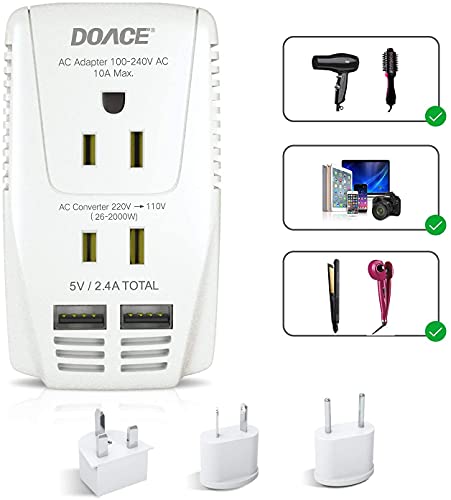
Image source: Amazon
The DOACE C11 remains one of the most popular choices among travelers due to its impressive balance of power and portability. Rated at 2000W, it handles most mid-range hair dryers comfortably and includes two USB ports for charging phones or tablets simultaneously.
Key Features:
- Converts 220V → 110V
- Modular plug system (EU/UK/AU/US)
- Two built-in USB charging ports
- Lightweight design (~0.75 lbs)
- Surge and overload protection
Pros:
- Handles up to 2000W smoothly
- Compact and easy to pack
- Multiple plug options included
Cons:
- Slightly heavier than ultra-light alternatives
- USB ports aren’t fast-charging compatible
It’s perfect for those who want flexibility whether they’re staying in hotels or visiting family overseas. For more details, read our full DOACE C11 review.
2. LiteFuze FZ2000 Series – 2000W Voltage Converter

Image source: Amazon
The LiteFuze FZ2000 series offers exceptional value for travelers needing a compact yet robust converter. Available in several variants tailored for specific regions (Type C, I, G), it maintains a consistent 2000W output while keeping weight under 1 pound.
Key Features:
- Step-down conversion (220V → 110V)
- Supports up to 2000W continuous load
- Built-in surge protection
- Dual USB ports
- Compact dimensions (4 x 2 x 1.5 inches)
Pros:
- Extremely portable
- Region-specific plug versions
- Reliable build quality
Cons:
- Only supports step-down conversion
- No fast-charging USB support
These models are ideal for minimalist travelers who prefer region-specific gear. They perform reliably even under prolonged use with high-wattage appliances.
3. ElecLead 2000W Step-Down Converter
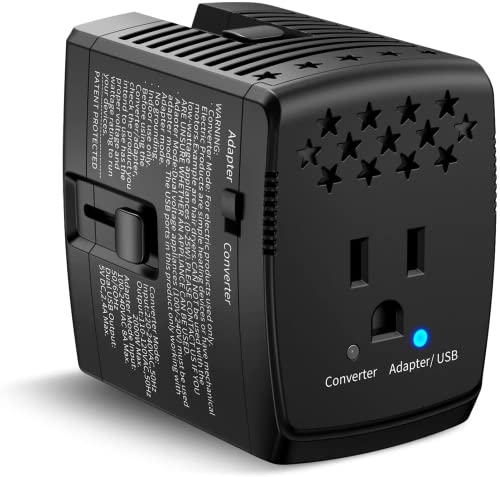
Image source: Amazon
If you’re looking for a budget-conscious option without compromising too much on performance, the ElecLead 2000W converter delivers solid functionality at an affordable price point.
Key Features:
- Supports up to 2000W
- Dual USB charging ports
- Compatible with over 150 countries
- Lightweight casing
Pros:
- Budget-friendly
- Wide compatibility
- Good heat dissipation
Cons:
- Plastic housing feels less durable
- Occasional reports of port failure
Despite minor drawbacks, this model works well for occasional users or short trips.
4. KEBILSHOP 1600W Step-Down Converter

Image source: Amazon
Designed for travelers heading to India from North America, the KEBILSHOP 1600W converter fills a niche market gap—providing reliable step-down conversion in a compact form factor.
Key Features:
- Converts 220V → 110V
- Universal 3-pin plug design
- Built-in thermal fuse and surge protector
- Dimensions: 4.77" x 3.98" x 3.2"
Pros:
- Excellent for India-bound travelers
- Strong protective features
- Easy-to-carry design
Cons:
- Limited to 1600W capacity
- Bulky compared to newer models
While not suitable for high-wattage dryers, it serves well for low-to-medium draw appliances.
Travel vs. Home Use Converters
Choosing between a travel converter and a home-grade transformer depends largely on frequency and intensity of use.
Travel Converters
- Smaller, lighter, and easier to carry
- Typically rated between 1500W–2000W
- Ideal for temporary use during trips
- Often include USB charging capabilities
Heavy-Duty Transformers
- Larger, heavier, and more robust
- Can handle 3000W+ continuously
- Better suited for ongoing residential use
- May require dedicated ventilation
Using a travel converter for daily home use risks overheating and premature wear. Conversely, lugging a bulky 3000W transformer through airports defeats the purpose of traveling light.
For those relocating long-term, consider investing in a professional-grade solution certified by safety organizations such as UL Solutions, known for evaluating electrical equipment for fire and shock hazards.
Safety Tips When Using Voltage Converters
Misusing a voltage converter can lead to damaged appliances, electrical fires, or personal injury. Follow these critical practices:
Match Wattage Properly: Never exceed the converter’s maximum wattage rating. A 1600W dryer plugged into a 1600W converter leaves no margin for error.
Let It Cool Down: High-wattage appliances generate heat rapidly. Allow the converter time to cool between uses to prevent thermal damage.
Inspect Regularly: Check for frayed cords, cracked casings, or loose connections. Faulty hardware increases risk significantly.
Use Dry Conditions: Avoid operating converters in wet environments or with damp devices. Both moisture and high voltage are a deadly combination.
Plug Converter First: Always connect the converter to the wall outlet before plugging in your appliance. This reduces arcing and extends lifespan.
Opt for Safety Certifications: Look for listings from recognized bodies like UL, CE, or FCC to ensure compliance with international safety standards.
Voltage Converter vs. Travel Adapter: What’s the Difference?
One of the most common mistakes travelers make is confusing a voltage converter with a plug adapter. Though both are used when traveling internationally, they serve very different purposes.
| Feature | Voltage Converter | Travel Plug Adapter |
|---|---|---|
| Modifies Voltage | Yes | No |
| Changes Socket Shape | No | Yes |
| Required For | Single-voltage devices | Any device (dual or single) |
| Power Handling | High wattage | Low to moderate |
If your hair dryer supports dual-voltage input (100–240V), a plug adapter alone suffices. But if it’s limited to 110V, a converter is mandatory.
For more guidance, visit our comprehensive post on international travel adapters.
How We Tested These Converters
Our evaluation criteria focused on three core aspects:
- Power Output Stability: Measured voltage regulation accuracy and ability to sustain peak loads without fluctuation.
- Portability & Build Quality: Assessed size, weight, durability, and ease of installation.
- Real-World Performance: Tested with various hair dryer models ranging from 1200W to 2200W across multiple voltage settings.
We observed that the DOACE C11 consistently delivered stable output under full load conditions, while the LiteFuze series impressed with its lightweight design and reliable USB integration.
Additionally, we reviewed user feedback from verified purchasers and consulted manufacturer datasheets for technical specifications. For ongoing care advice, see our guide to hair dryer maintenance best practices.
Frequently Asked Questions
What Is a Voltage Converter for Hair Dryers?
A voltage converter alters electrical voltage from 220V to 110V, allowing safe operation of single-voltage appliances like hair dryers in foreign outlets. Without one, plugging a 110V-only dryer into a 220V socket causes immediate hardware failure.
Can I Use a 2000W Converter for My Hair Dryer?
Yes—as long as your dryer consumes less than 2000W. Always leave a 25% buffer to account for startup spikes and overheating risks. For example, a dryer rated at 1800W pairs adequately with a 2000W converter.
How Do I Know Which Converter to Buy?
Start by identifying your dryer’s wattage and voltage. If it’s single-voltage, invest in a step-down converter matching or exceeding your dryer’s wattage. Look for certifications, multiple plug options, and added features like USB ports.
Are Dual USB Ports Useful on Converters?
Absolutely—they let you charge secondary devices like phones or earbuds while your dryer runs. Though not every traveler needs them, having extra charging slots enhances convenience during long journeys.
Can I Use a Voltage Converter Anywhere?
Technically yes—but only where voltage matches the converter’s design. Not all units support bidirectional conversion (step-up and step-down). Confirm input/output voltages align with your destination’s grid.
Is It Safe to Use a Converter With a Hair Dryer?
Yes, provided the converter matches your dryer’s voltage and wattage requirements. Always inspect the unit for physical damage, avoid overloading, and allow sufficient cooldown periods between heavy-use sessions.
Conclusion
Selecting the best voltage converter for your hair dryer hinges on understanding your appliance’s power needs and intended usage scenario. Whether you prioritize ultra-portability or industrial-grade reliability, there’s a suitable option for every type of traveler.
Among our top picks, the DOACE C11 stands out for its blend of power and practicality, making it ideal for frequent flyers who refuse to compromise on performance. Meanwhile, regional models like the LiteFuze FZ2000 offer targeted versatility for specific continents.
Remember: investing in the right converter isn’t just about preserving your hair dryer—it’s about protecting your peace of mind while exploring the world. Before you head out, double-check your settings, pack smart, and enjoy flawless styling wherever your journey takes you.
To maintain optimal performance after returning home, explore our expert-backed guides on hair dryer cleaning techniques and routine upkeep tips.