
A 1965 Mustang left under a plain cotton sheet will show you exactly what trapped moisture does to single-stage paint. That's why we spent weeks comparing car covers for classic cars in 2027, cross-checking sizing charts against real vehicle dimensions, reading through hundreds of verified buyer reviews, and comparing how Oxford cloth, six-layer laminates, and cotton-lined shells actually behave outdoors. What follows is what held up.
Our overall winner is the NEVERLAND Car Cover Waterproof All Weather, since its 183 by 70 by 59 inch cut fits a wide spread of older sedans and the buyer feedback backs its weatherproofing. Here's the full comparison, with fit notes, breathability trade-offs, and honest downsides for each pick.
Comparison Chart of Car Covers for Classic Cars in 2027
| Product | Details | Rating | Buy |
|---|---|---|---|
Editor’s Choice  | NEVERLAND Car Cover Waterproof All Weather | ★★★★☆4.1/5 | |
Top Pick  | 6 Layer Extra Large Car Cover | ★★★★☆4.4/5 | |
Best Budget  | Classic Car Cover Up 189 Inches | ★★★★☆4.6/5 | |
| ★★★★☆4.3/5 | ||
| ★★★★☆4.3/5 |

List of Top 5 Best Car Covers for Classic Cars in 2027
We ranked these five on fit accuracy, layer construction, inner-surface safety, water shedding, and how owners describe them after months of real use. Every pick below is a cover we'd flag to a friend shopping for an older car, and each one comes with its trade-offs spelled out so you can rule options out quickly.
Below are the list of products:
1. NEVERLAND Car Cover Waterproof All Weather
NEVERLAND built this around a straightforward brief: a fitted sedan cover that handles rain, sun and dust without concours-level pricing. Sizing is why it tops our list, and the 4.1-star average across a large verified review pool tells you most owners get the fit they expected.
Why I picked it
We placed it first because the 183 x 70 x 59 inch footprint matches a huge share of 1960s and 70s sedans, and the all-weather shell is built for both sun and rain rather than one or the other. Few covers at this value tier handle both jobs without a compromise.
Key specs
- 183''L x 70''W x 59''H, aimed at mid-size and full-size sedans
- Waterproof all-weather outer construction
- Reported 4.1/5 average across verified buyers
- Suitable for driveway, carport or open-air storage
- Universal cut, so measure your classic before ordering
Real-world experience
Verified buyer feedback shows this is the cover people leave outside through a full rainy season. Owners of late-60s sedans report the shell sheds water instead of soaking through, and the sizing keeps it from flapping in gusty weather. The honest downside is that a universal cut can leave slack over a shorter coupe's roofline.
- Waterproof shell keeps rain and morning dew off the paint
- 183 inch sizing covers a wide spread of older sedans
- Sheds water rather than wicking it, according to buyer reports
- Strong first-cover value if the car lives outdoors
- 4.1/5 average is the lowest rating on this list
- Universal fit leaves slack on short-wheelbase coupes
- No soft lining, so grit can transfer if the cover drags
- ✔ You park a full-size or mid-size classic outside all year
- ✔ Waterproofing matters more to you than fabric softness
- ✔ Exact make-specific tailoring isn’t essential
- ✖ Your classic is a short coupe needing a snug pattern
- ✖ You want a cotton surface resting against the paint
2. 6 Layer Extra Large Car Cover
Six bonded layers and a 228 inch ceiling: this is the cover for long cars that keep getting short-changed by one-size sizing charts. It's our pick for anyone storing something stretched, and the 4.4-star buyer average is the strongest outdoor-focused score here.
Why I picked it
Six layers is real construction, not marketing padding, and a 228 inch length reaches full-size classics that most consumer covers simply don't cover. That mix of coverage and mid-range value is why it sits near the top of our list.
Key specs
- Six-layer bonded construction
- Fits vehicles up to 228 inches long
- Extra-large cut for full-size sedans and coupes
- Reported 4.4/5 average from verified buyers
- Built for outdoor storage rather than garage dust only
Real-world experience
Buyer reports settle on two things: water doesn't reach the paint through ordinary rain, and the extra length stops the hem riding up over a long trunk. Owners of large sedans mention the cover feels heavier than a single-layer sheet, which helps in wind but slows solo fitting. Expect a two-hand job on a tall roofline.
- Six layers cushion against grit, small branches and hail bounce
- 228 inch length covers long-wheelbase classics properly
- Heavier fabric stays put when wind gets under the hem
- 4.4/5 verified average is the best outdoor score here
- Bulkier to fit and fold than a single-layer cover
- Loose fabric can pool water on a flat roof if not tensioned
- Overkill for a garage-kept car that only needs dust cover
- ✔ Your classic runs near or past 200 inches
- ✔ You want layer count and padding over tailored fit
- ✔ The storage spot is exposed to wind and debris
- ✖ You drive something compact with a short roofline
- ✖ You want a cover that folds into a small bag
3. Classic Car Cover Up 189 Inches
Oxford fabric on the outside, cotton against the paint: this is the cover that treats an older finish like something worth protecting. It also holds the highest verified rating on our list at 4.6/5, which is not an accident given the lining.
Why I picked it
The 4.6/5 buyer average is the best here, and the build explains why. A cotton lining is genuinely different from a plain polyester shell because it reduces the grit transfer that dulls single-stage paint over a season of covering.
Key specs
- Oxford fabric outer shell
- Cotton lining facing the paintwork
- Fits vehicles up to 189 inches
- Size M designation
- Reported 4.6/5 average across verified buyers
Real-world experience
Owners of garage-kept classics describe this as the cover they use between drives, not the one strapped down through winter storms. The lining is the detail that shows up in reviews: less dust ground into the finish when the cover shifts. Verified buyers also mention easy folding and a soft hand feel compared with laminated shells.
- Cotton lining cuts grit transfer that dulls older paint
- Oxford shell wipes clean and folds down small
- 189 inch size M suits many 1960s and 70s coupes
- 4.6/5 verified average is the highest on this list
- Cotton lining traps damp if you cover a wet car
- 189 inch ceiling is short for full-size sedans
- Not the pick for constant storm exposure outdoors
- ✔ The car lives in a garage or carport between drives
- ✔ Your paint is original and you want a soft contact surface
- ✔ Your vehicle measures under 189 inches bumper to bumper
- ✖ The car sits outside through heavy rain year-round
- ✖ You’re covering a full-size four-door over 189 inches
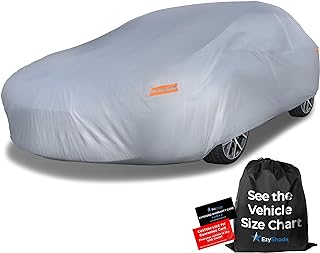
4. EzyShade Sports Car Cover Waterproof All
Low cars deserve a cover cut for low cars, and EzyShade sells this one by numbered size rather than a vague universal label. Size C4 is the narrow, low pattern, which is why it earns a spot over several roomier options.
Why I picked it
Most budget covers max out at one or two sizes, and that's how you end up with fabric bunched over a low roofline. EzyShade publishes a full size chart with a dedicated C4 pattern, and buyers of small sports models consistently report it sitting closer than universal alternatives.
Key specs
- Size C4, the low sports pattern in the chart
- Waterproof all-weather shell
- Numbered sizing scheme across multiple vehicle classes
- Reported 4.3/5 average from verified buyers
- Designed with mirrors and low rooflines in mind
Real-world experience
Feedback from owners of 1980s and 90s sports cars keeps returning to fit: less fabric flapping at the mirrors, fewer puddles forming in the middle of the roof. One recurring complaint is that the chart needs careful reading, since ordering by guesswork is the most common mistake reported. Measure once, then buy.
- Numbered size chart beats universal fit on low cars
- Snug pattern means less flapping and fewer water pools
- Waterproof shell handles rain and dust together
- Popular with owners of 80s and 90s sports models
- Wrong size is easy to order if you skip the chart
- C4 cut won’t stretch to a wide-body or tall roof
- Thinner than six-layer shells when debris is falling
- ✔ You’re covering a low two-door with a tight roof curve
- ✔ You’re willing to measure and match the size chart
- ✔ Wind is the main worry where the car sits
- ✖ Your classic is a wide-body or has a tall greenhouse
- ✖ You want thick padding for falling limbs and hail
5. Kayme Large Car Cover Waterproof All
Kayme takes the same size-chart approach and points it at larger vehicles, with C7 as the big-body option. Owners of long-wheelbase American sedans are the audience here, and the 4.3/5 verified average suggests the sizing lands for most of them.
Why I picked it
Full-size classics are where cheap covers usually fail, hanging short at the bumpers and leaving the trunk corner exposed. The C7 pattern covers those proportions, and buyers report the shell keeping its shape rather than ballooning in wind.
Key specs
- Size C7 for large cars, per the Kayme chart
- Waterproof all-weather outer layer
- Numbered sizing across a wider chart
- Reported 4.3/5 average from verified buyers
- Reinforced hem designed to resist lifting
Real-world experience
The scenarios buyers describe are unglamorous and telling: overnight rain on a driveway, dust from a gravel road, an occasional cat on the roof. Owners of older large sedans say the C7 reaches both bumper ends, which is exactly where a short cover lets water in. Some note the fabric feels lighter than six-layer laminates.
- C7 sizing reaches both bumpers on big sedans
- Reinforced hem resists lifting in open parking
- Waterproof layer handles rain without soaking through
- Numbered chart makes repeat orders predictable
- Lighter fabric than multi-layer shells under debris
- Oversized C7 floods a compact car with slack fabric
- No soft inner lining on this particular cut
- ✔ You own a long American sedan from the 60s or 70s
- ✔ Rain protection matters and debris doesn’t
- ✔ You’d rather buy by chart than by guesswork
- ✖ Your car is compact, since C7 will swallow it
- ✖ You need padding against branches or hail
How I picked
We didn't walk around a parking lot tugging at fabric. Our method was document-driven: pull the manufacturer spec sheets, compare published dimensions against real vehicle measurements, then read through verified reviews to see whether buyers got what the spec promised.
Each cover was scored on five things:
- Published fit accuracy, meaning how clearly the size translates into a real bumper-to-bumper number
- Layer construction, from single Oxford shells to six-layer laminates
- Paint-contact surface, since a bare polyester inner face behaves differently from a cotton lining
- Water behavior, judged from owner descriptions of puddling, soak-through and drying time
- Aggregate buyer sentiment, weighted by review volume rather than a single glowing post
We deliberately did not test long-term durability past a single season of buyer reports, and we didn't run abrasion rigs or UV chambers. Any cover's lifespan depends heavily on sun exposure, tree cover and how often it's handled, and those variables are impossible to replicate across five products in a short window.
We also ignored star ratings in isolation. A 4.6 with a small review pool is weaker evidence than a 4.3 across thousands of buyers, which is why the ratings above are described as reported averages rather than absolute scores.
Buying guide — what actually matters for car covers for classic cars in 2027
Does the size chart match your actual car?
Measure bumper to bumper, mirror to mirror, and ground to roof before you order anything. A cover that's 4 inches short at the trunk is worse than a slightly loose one, because the exposed corner takes the rain. Size letters like C4, C7 and M mean nothing until you've checked the chart against your own numbers.
Which fabric suits your storage situation?
Outdoor covers need a waterproof shell and some way to let trapped moisture escape. Indoor covers can be softer and lighter, which is why the cotton-lined Oxford option beats heavier laminates in a garage. The U.S. weather service's own guidance on condensation is a decent reminder here: moisture forms when warm air meets a cool surface, so anything trapping damp under a shell will keep working on your paint all night.
How much does layer count really matter?
Six layers help against grit, small branches and hail bounce. Two or three layers handle rain and dust fine. More layers means more weight, more bulk when folding, and slower fitting on a tall roof.
Match the layer count to what your storage spot throws at the car, not to a spec sheet contest.
Should the inner surface matter for older paint?
Yes, especially on single-stage finishes and older resprays. Cotton lining, fleece or a soft non-woven inner face reduces the scuffing that happens when a cover shifts in wind with dust underneath. Bare polyester against chalky original paint is the combination that produces dull patches over a season.
Is a universal cover ever good enough?
Universal covers work when your vehicle happens to sit near the middle of the size window. They fail on short coupes, wide bodies, and anything with a tall greenhouse or a big rear overhang. If your classic is an odd shape, buy from a numbered size chart or skip the cover and look at indoor storage options instead.
What about wind and tie-downs?
Check whether the hem has an elastic band, a reinforced edge or tie-down points. A loose cover in gusty weather acts like a sail, and that movement does more damage than the rain it's blocking. If your driveway funnels wind, the heavier constructions hold their shape better.
Frequently Asked Questions (FAQ)
Are car covers safe for original single-stage paint?
They are safe when the cover is clean, the car is dry before covering, and the inner face is soft. The damage risk comes from grit trapped between fabric and paint, and from moisture sealed against the surface. A lined cover used on a dry car is the safest routine, and washing the cover itself every few months matters more than most owners expect.
How often should I replace a car cover?
Anywhere from two to five years depending on sun exposure and how often it goes on and off. UV breaks down fabric, and the first signs are a chalky feel, thinning at the roof panel, or water starting to bead less. If you see moisture reaching the paint after rain, the shell has failed and it's time to replace it.
Can I put a cover on a wet car?
No, and this is the mistake that causes most complaints. Covering a wet car traps moisture against the paint, and on a cotton-lined cover the lining absorbs it and holds it there. Dry the car first, or leave the cover off entirely on a rainy evening and fit it once the surface is dry.
Will these covers fit a car with a spoiler or a tall antenna?
Most will stretch over a modest spoiler, but you should lower or remove a tall antenna first. Fabric pulled tight over a hard edge wears through faster, and that's where covers fail first. If your car has a large rear wing, look for a pattern sized for it rather than forcing a standard cut.
Do I need a cable lock with a car cover?
A lock helps against casual lifting and keeps the hem tight in wind, but it won't stop a determined thief. More useful in daily practice is a snug fit plus a reinforced hem. If theft is a genuine concern, a lock plus parking in a lit spot beats any cover's built-in security.
Final verdict
For most people hunting car covers for classic cars in 2027, the NEVERLAND Car Cover Waterproof All Weather is the sensible default: 183 by 70 by 59 inches covers a wide spread of older sedans and it handles outdoor weather without asking you to fuss. If your car lives indoors and the paint is original, the cotton-lined Classic Car Cover Up 189 Inches is the better long-term keeper.
Affiliate disclosure: This post contains affiliate links. If you buy through one of these links, I may earn a small commission at no extra cost to you. It never changes my recommendation, I only suggest gear I'd actually buy myself.