
Knowing how to maintain a sump pump battery prevents catastrophic basement flooding during power outages. Your maintenance routine depends entirely on whether you own a flooded lead-acid or sealed AGM unit.
Battery Council International standards confirm that proper electrolyte management extends deep-cycle battery life by up to three years as of 2026. We will walk through the exact conditional steps your specific system requires next.
how to maintain a sump pump battery
Maintain your sump pump battery by identifying its chemistry first. Check electrolyte levels monthly for flooded cells only. Clean terminals and apply dielectric grease quarterly.
Test specific gravity with a hydrometer every three months. Verify charger output voltage annually against manufacturer specs. Never add water to sealed AGM batteries.
Identify Your Battery Type Before You Touch Anything
Your maintenance path splits immediately based on battery construction. Flooded lead-acid batteries have removable caps for adding distilled water. Sealed AGM or gel batteries are completely closed systems requiring zero fluid checks.
Treating them identically causes permanent damage or dangerous acid spills.
Check the label for "flooded," "wet cell," "AGM," or "gel" designations. If caps are present and twist off, you have a flooded battery needing regular watering. Smooth tops without seams indicate a sealed unit that relies solely on voltage monitoring.
This distinction dictates every subsequent step in this workflow.
Safety First: Ventilation, PPE, and Spark Prevention
Flooded batteries emit explosive hydrogen gas during charging cycles. Always wear safety glasses and acid-resistant gloves before opening caps. Ensure your sump pit area has adequate ventilation per NEC Article 480 guidelines.
Never create sparks or use open flames near the battery compartment.
Sulfuric acid causes severe burns on contact with skin. Keep baking soda nearby to neutralize accidental spills immediately. Disconnect the negative terminal first when performing any electrical work.
Reconnect it last to prevent short circuits across metal tools or surfaces.
The Conditional Maintenance Workflow: What to Do and When
Monthly inspections catch corrosion before it blocks current flow. Inspect terminals for white or green crusty buildup each visit. Tighten connections to manufacturer torque specifications, typically five to seven foot-pounds.
Apply dielectric grease after cleaning to slow future oxidation in damp environments.
Sealed battery owners can stop here for fluid-related tasks. Focus instead on verifying charger indicator lights show proper operation. Listen for unusual humming or excessive heat from the control box.
These signs often precede charger failure long before the battery itself degrades.
Quarterly Electrolyte and Voltage Testing (Flooded Only)
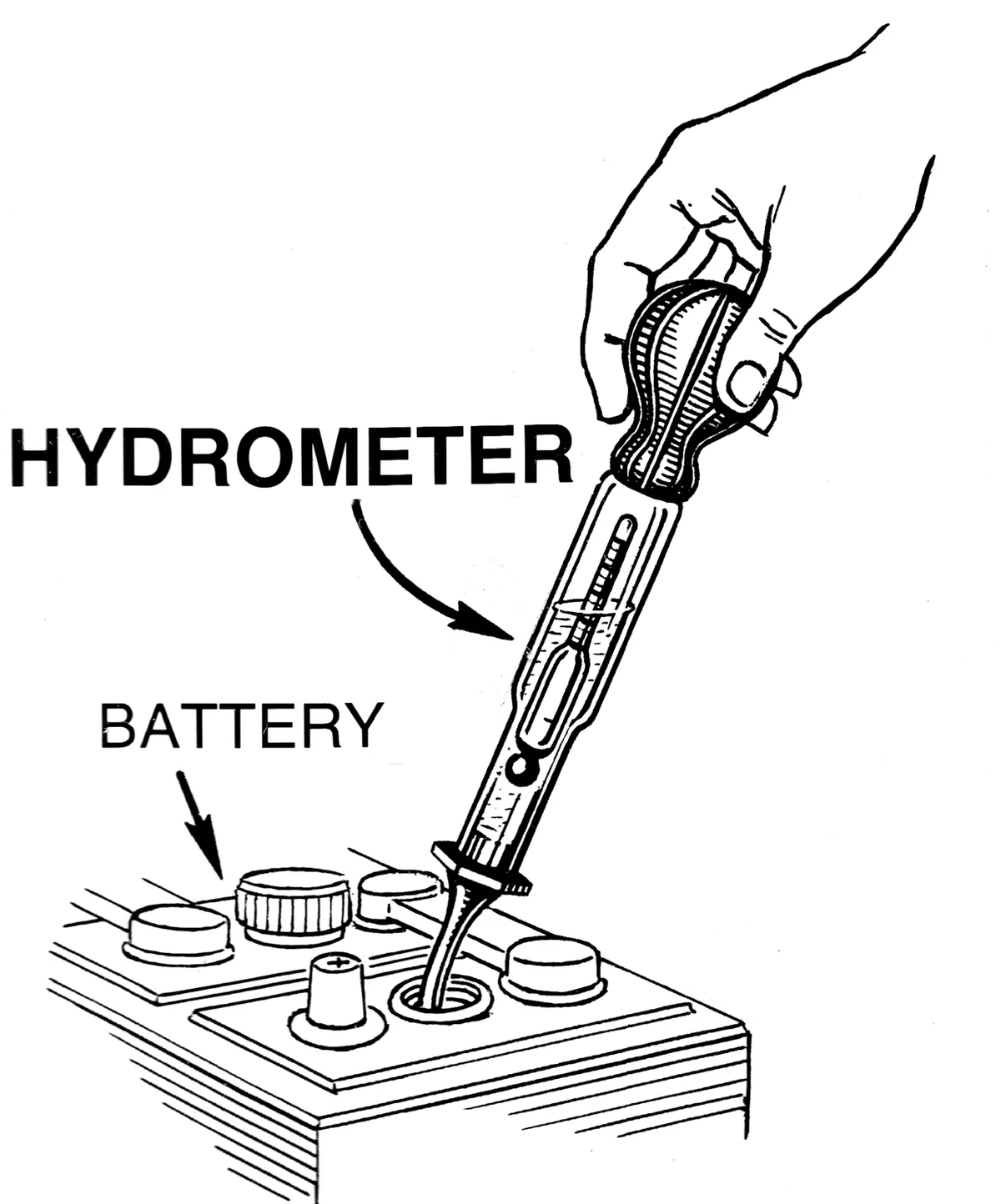
Image source: Wikimedia Commons / Pearson Scott Foresman
Use a battery hydrometer to measure specific gravity in each cell. Readings should fall between 1.265 and 1.275 for a full charge. Variance exceeding 0.030 between cells indicates sulfation or internal failure.
Record these numbers to track degradation trends over time.
Top off low cells with distilled water only, never tap water. Fill to just below the split ring indicator inside each port. Overwatering dilutes acid concentration and causes overflow during charging.
Perform this check before equalization cycles to prevent dry plate exposure.
Annual Load Testing and Charger Verification
Voltage readings alone do not reveal true battery health under load. Use a dedicated conductance tester or carbon pile load tester annually. The battery must sustain at least 9.6 volts for fifteen seconds at half its CCA rating.
Failure means replacement is overdue regardless of age.
Verify charger output matches the battery's absorption voltage specification. Most flooded units require 14.4 to 14.8 volts during bulk charging. Float voltage should stabilize between 13.2 and 13.8 volts continuously.
Incorrect profiles accelerate water loss or cause chronic undercharging.
Storage and Seasonal Preparation Protocols
Disconnect batteries if leaving seasonal properties unmonitored for months. Store in a cool, dry location away from freezing temperatures. Charge fully before storage and recharge every sixty days minimum.
Self-discharge rates increase significantly in warmer conditions.
Reconnect and test the entire backup system before storm season returns. Run the pump manually to verify motor function and switch operation. Confirm alarm circuits activate properly when water rises.
This pre-season validation catches failures while you still have time to fix them.
Common Maintenance Mistakes That Kill Backup Batteries
Adding tap water introduces minerals that permanently reduce capacity. Using automotive chargers instead of multi-stage smart chargers boils off electrolyte. Ignoring terminal corrosion creates resistance that mimics battery failure.
These errors account for most premature replacements we see in field reports.
Assuming a green charger light means the battery is healthy is equally dangerous. Chargers monitor voltage, not actual amp-hour capacity or internal resistance. Only load testing reveals whether the battery can actually run your pump.
Trust instruments over indicator LEDs for critical backup systems.
Misreading Voltage as State of Health
A resting voltage of 12.6 volts suggests full charge but proves nothing about runtime. Sulfated batteries often show perfect voltage yet fail under minimal load. This false confidence leaves homeowners vulnerable during extended outages.
Always pair voltage checks with periodic load or conductance testing.
Equalization charges help reverse mild sulfation in flooded batteries only. Applying this high-voltage cycle to AGM or gel batteries destroys them. Consult manufacturer documentation before enabling this feature on any charger.
Wrong settings void warranties and create safety hazards instantly.
Frequently Asked Questions
How often should I actually test my backup battery?
Test flooded batteries quarterly with a hydrometer and annually with a load tester. Sealed AGM units need only annual load testing since fluid checks are impossible. Monthly visual inspections apply to all types for terminal condition and charger status.
Consistency matters more than frequency for catching gradual decline.
Can I use a car battery instead of a deep-cycle marine battery?
No, starting batteries cannot handle sustained discharge cycles required by sump pumps. They will fail within months due to plate degradation from deep cycling. Deep-cycle marine or RV batteries are engineered specifically for this application.
Using the wrong type risks flooding during your next outage.
My charger shows full but the pump won't run. What is wrong?
The battery may have lost capacity despite showing correct voltage. Internal sulfation or dried cells prevent current delivery under load. Test with a conductance meter to confirm actual health.
Replace the battery if it fails load testing regardless of charger indication.
Is it safe to keep a flooded battery in an enclosed sump pit?
Only if the pit has active ventilation meeting NEC Article 480 requirements. Hydrogen gas accumulates rapidly during charging and poses explosion risk. Install vent tubing routing gases outside if airflow is inadequate.
Sealed AGM batteries eliminate this hazard entirely in confined spaces.