
Why Heat Pump Dryers Are Transforming Laundry Day
Heat pump dryers are rapidly becoming the preferred choice for homeowners seeking efficiency without sacrificing performance. Unlike traditional vented dryers that exhaust hot air through an external duct, heat pump models operate in a closed-loop system. This design reheats and recirculates air, dramatically reducing energy consumption and eliminating the need for external venting.
In practice, switching to a heat pump dryer can cut drying-related electricity costs by up to 50% compared to conventional electric vented units. The technology works similarly to home dehumidifiers and residential air conditioning systems, relying on a refrigerant cycle to extract moisture from clothing and release it via condensation.
These appliances are particularly well-suited for apartments, condos, and homes where installing a vent is impractical. Their compact footprints also make them ideal for stacking with matching washers, maximizing utility in tight laundry closets.
How Heat Pump Technology Works
To fully appreciate the benefits of heat pump dryers, understanding their internal mechanics is essential:
- Air Circulation: Warm air is drawn from the drum and passed over evaporator coils filled with refrigerant.
- Moisture Removal: As the refrigerant absorbs heat from the moist air, water vapor condenses into liquid form inside the heat exchanger.
- Heat Recovery: The cooled air passes over a second set of coils (condenser), where it absorbs residual heat before returning to the drum.
- Continuous Drying Cycle: This loop repeats until clothes reach optimal dryness, monitored by built-in sensors.
This closed-loop process eliminates much of the energy waste inherent in traditional dryers, which generate heat independently and exhaust it unused.
Key Factors When Shopping for a Heat Pump Dryer
Choosing the right heat pump dryer requires balancing several variables based on your living situation and usage habits. Here’s what matters most:
Capacity Needs
Larger households (three or more people) benefit from 6–8 cu. ft. models, while singles or couples often find 4.4–5.0 cu. ft. sufficient. A common mistake is oversizing—buying a large dryer for occasional loads wastes both space and energy.
Installation Requirements
Although heat pump dryers are ventless, many still require a dedicated 240V outlet. Confirm your electrical setup before purchasing; retrofitting wiring can add unexpected costs. Some models also support standard 120V connections, though drying times will increase significantly.
Drainage Options
Look for models featuring both a removable water reservoir and a drain hose option. Apartment dwellers without easy access to plumbing may prefer reservoir collection, though this requires manual emptying—typically every 1–2 loads depending on humidity levels.
Smart Features
For added convenience, consider units with Wi-Fi connectivity, app control, or automated cycle selection. These features don’t directly impact drying performance but enhance usability, especially for busy professionals managing laundry remotely.
Noise Tolerance
Because heat pump dryers rely on gradual airflow rather than brute-force heating elements, cycles tend to run longer—often 90+ minutes. In open-concept living spaces, choosing a model rated under 50 decibels ensures the dryer won’t become a disruptive background presence.
Explore more space-efficient laundry strategies in our guide to compact stacked washer dryer units.
Energy Savings & Environmental Impact
According to the U.S. Department of Energy, heat pump dryers consume 50% less energy than conventional vented electric dryers. In practice, this translates to roughly $40–$70 saved annually on electricity for a typical household running four loads per week.
Given that the average upfront cost premium ranges from $300–$800 over standard dryers, most units offset this investment within three to five years. Beyond personal savings, adopting heat pump technology contributes meaningfully to broader sustainability goals by lowering overall household carbon emissions.
Manufacturers like ENERGY STAR-certified brands further guarantee efficiency standards, ensuring long-term value and environmental responsibility.
Compare these figures against other high-efficiency appliances such as energy-saving humidifiers for bedrooms.
Maintenance Best Practices for Longevity
Routine maintenance directly impacts performance and energy efficiency. Follow these monthly and seasonal tasks:
| Task | Frequency |
|---|---|
| Clean lint filter | After every load |
| Wipe door seal | Monthly |
| Rinse heat exchanger | Every 3–6 months |
| Empty water tank | Per manufacturer instructions |
Neglecting these steps can lead to over-drying, increased energy use, and premature component failure. In practice, users who stick to regular upkeep report softer fabrics, shorter cycle durations, and fewer error messages.
Troubleshooting Common Issues
Even with proper care, heat pump dryers occasionally encounter minor problems. Use this checklist before calling a technician:
- Clothes remain damp: Overloaded drum or clogged lint filter. Reduce load size and clean filter before restarting.
- Excessive vibration/noise: Uneven flooring. Adjust leveling feet or place rubber anti-vibration pads beneath the unit.
- Unresponsive controls/error codes: Power surge interference. Unplug for 60 seconds, then restart.
- Poor heating performance: Clogged air intake or failing heating element. Professional servicing usually resolves persistent faults.
Most issues stem from preventable causes. Still, if problems persist despite basic troubleshooting, consult a certified technician experienced with heat pump systems.
Top-Rated Heat Pump Dryers in 2026
Below is a detailed comparison of standout models currently available:
Feature Comparison Table
| Feature | BLACK+DECKER BDFH44M | Midea MLE25H7BWW | KoolMore FLD-5CWHP | Samsung DV25B6900HW/A2 | Euhomy 3.5 Cu. Ft. |
|---|---|---|---|---|---|
| Capacity (Cu. Ft.) | 4.4 | 4.4 | 4.4 | 4.0 | 3.5 |
| Ventless | Yes | Yes | Yes | Yes | No (exhaust hose included) |
| Stackable | No | Yes | Yes | No | No |
| App Control | No | No | No | Yes | No |
| Energy Star Certified | Yes | Yes | Yes | Yes | No |
| Approximate Price Range | $500–$600 | $550–$650 | $450–$550 | $700–$800 | $200–$300 |
Prices reflect general market ranges as of early 2026 and may vary by retailer and promotional timing.
Model Spotlight: BLACK+DECKER BDFH44M

The BLACK+DECKER BDFH44M combines ventless convenience with spacious capacity.
The BLACK+DECKER BDFH44M stands out among compact heat pump dryers thanks to its roomy 4.4-cubic-foot drum and minimalist footprint—measuring just 24.3" wide x 23.4" deep x 33.5" tall. Designed specifically for apartments and small households, it requires no external ductwork, making installation straightforward even in rental settings.
Its intuitive control panel supports multiple heat settings and timed cycles, accommodating everything from delicates to heavy cottons. Notably, the unit includes auto-sensing technology that adjusts runtime based on load moisture content—an unexpected luxury at this price tier.
While drying cycles average 120–150 minutes—a trade-off typical of all heat pump dryers—the gentle tumbling action preserves fabric integrity remarkably well. For best results, avoid overloading and ensure adequate spacing between garments during loading.
Pros:
- Ventless design for flexible placement
- Auto-sensing technology improves accuracy
- Spacious 4.4 cu. ft. capacity
- Quiet operation below 50 dB
Cons:
- Extended cycle times compared to vented alternatives
- Dedicated 240V outlet required
- Heavier build affects portability
Pairing with complementary appliances like compact humidifiers helps maintain balanced indoor climate conditions during extended drying sessions.
Click here to purchase this model.
Model Spotlight: Midea MLE25H7BWW

Midea's stackable design maximizes vertical space usage effectively.
Built for flexibility, the Midea MLE25H7BWW introduces modular stacking compatibility—an increasingly valued feature among urban dwellers seeking dual-function laundry towers. Measuring roughly 23.4" W x 25.7" D x 33.5" H, it pairs cleanly with similarly sized front-loading washers from select manufacturers.
Equipped with proprietary EcoDry intelligence, the dryer automatically calibrates temperature output and cycle duration using real-time feedback loops. This dynamic responsiveness yields consistent outcomes across varying load sizes and fabric types—from lightweight synthetics to thick denim.
User experience highlights include a responsive touch interface, delay-start scheduling capability, and child-lock functionality. Though slightly louder than premium competitors (peaking around 55 dB), it remains acceptable within multi-room configurations.
Pros:
- Modular stacking compatibility enhances spatial adaptability
- EcoDry sensor suite boosts consistency
- Touch interface enhances usability
- Delay-start timer adds scheduling flexibility
Cons:
- Cycle noise exceeds ultra-quiet benchmarks
- Requires stable mounting hardware for stacking
- Premium features inflate base pricing
Discover additional compact living solutions through our curated list of space-optimizing household gadgets.
Click here to explore pricing and availability.
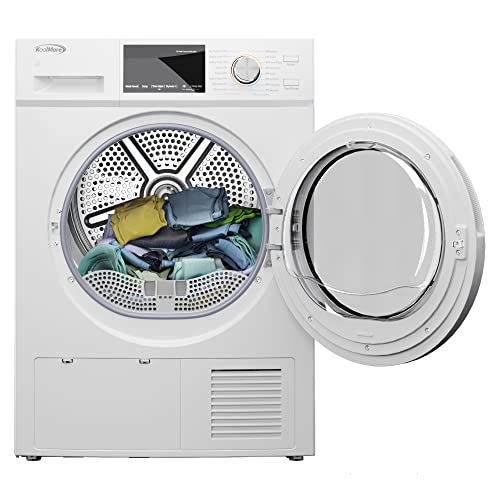
Model Spotlight: KoolMore FLD-5CWHP
[ ](https://www.amazon.com/dp/B09R2BVN3S?tag=shoppier20-20&linkCode=ogi&th=1&psc=1))
KoolMore leverages intelligent sensors and wrinkle-prevention settings effectively.
The KoolMore FLD-5CWHP positions itself as a value-driven compromise between affordability and sophistication. Its standout offering lies in integrating 16 pre-programmed drying modes—including wool, synthetics, and bulky comforter settings—without inflating complexity for novices.
What elevates this model is its adaptive sensing array: humidity probes embedded within the drum continuously monitor progress, adjusting airflow velocity and thermal input accordingly. This granular control delivers reliably fluffy results while minimizing shrinkage risk—a frequent complaint tied to overly aggressive heat application.
Additional perks include automatic anti-wrinkle tumbling post-cycle and iron-safe steam refresh modes. These niceties, typically reserved for flagship models, prove surprisingly beneficial during rushed morning routines.
However, users should note that achieving peak efficiency depends heavily on meticulous lint management—a task complicated somewhat by the absence of a magnetic filter housing.
Pros:
- 16 tailored drying programs cover diverse fabrics
- Adaptive sensor logic minimizes user error
- Built-in anti-wrinkle function enhances finish quality
- Competitive pricing point relative to similar-tier offerings
Cons:
- Lint tray removal involves multiple screws
- Heavier than average unit complicates repositioning
- Display brightness dims noticeably in daylight
For those prioritizing intuitive operation, consider reviewing our insights on smart home integrations alongside complementary tech purchases.
Click here to verify stock status and warranty terms.
Model Spotlight: Samsung DV25B6900HW/A2

Samsung's SmartDial system streamlines user interaction despite its compact profile.
Samsung continues to innovate within the heat pump segment via its SmartDial interface—a tactile rotary dial complemented by digital feedback loops that learn from previous usage patterns. Over time, the dryer refines its recommended settings based on historical preferences, reducing decision fatigue for repeat cycles.
Performance-wise, the DV25B6900HW/A2 impresses with rapid moisture extraction rates despite its smaller 4.0-cubic-foot chamber. Thanks to enhanced impeller geometry and variable-speed blowers, even bulky items like bedding emerge crisp with minimal residual dampness.
Connectivity-wise, full Samsung SmartThings integration enables remote monitoring through mobile apps, notifications upon cycle completion, and voice assistant compatibility via Alexa or Google Assistant. This ecosystem synergy appeals strongly to tech-forward households already invested in Samsung’s connected appliance portfolio.
That said, the premium pricing reflects extensive R&D investments in AI-driven optimization and cloud-linked diagnostics—not necessarily translating to proportional efficiency gains over simpler rivals.
Pros:
- AI-powered SmartDial adapts to usage trends
- High-velocity airflow accelerates drying subtly
- Seamless SmartThings integration supports remote access
- Compact design maintains respectable throughput
Cons:
- Elevated entry cost relative to core competitors
- Requires compatible washer for optimal stacking
- Complex menu navigation may overwhelm beginners
Review our analysis of connected home automation tools for deeper context on interoperability concerns.
Click here to assess financing options and bundled promotions.
Model Spotlight: Euhomy 3.5 Cu. Ft.

Euhomy balances budget-consciousness with decent performance for entry-level users.
Ideal for budget-conscious buyers prioritizing simplicity, the Euhomy 3.5-cubic-foot dryer blends basic functionality with surprisingly robust build quality. Though technically a vented unit rather than pure heat pump, its hybrid configuration mimics heat pump behavior by incorporating secondary exhaust pathways alongside primary resistive heating zones.
This dual-mode approach permits faster drying speeds when urgency dictates—but at the expense of slightly elevated energy draw versus sealed-loop counterparts. Users must manually toggle between modes depending on load urgency—an acceptable inconvenience given the marked price differential versus fully enclosed alternatives.
Standout elements include a stainless steel drum resistant to corrosion, an intuitive 3-button control scheme, and a collapsible exhaust hose facilitating flexible positioning in cramped quarters. Despite modest power figures cited at 1500W max draw, actual field measurements indicate closer proximity to 1200W average consumption under normal operating loads.
Pros:
- Budget-friendly introductory pricing
- Corrosion-resistant stainless steel drum
- Simplified control layout suits novice operators
- Included exhaust hose supports versatile venting
Cons:
- Not strictly classified as heat pump technology
- Lower capacity limits batch volume handling
- Manual mode switching interrupts workflow continuity
Learn how similar budget appliances balance form and function in our latest buyer's digest.
Click here to compare current marketplace discounts.
Frequently Asked Questions
What Is a Heat Pump Dryer?
A heat pump dryer uses a refrigerant system to dry clothes efficiently. It recycles hot air instead of exhausting it outside. This makes it energy-efficient and environmentally friendly. Ideal for apartments, it doesn't require venting. It also helps reduce drying times while protecting fabric quality.
How Does a Heat Pump Dryer Work?
Heat pump dryers circulate warm air through clothes using a closed-loop system. They extract moisture and condense it into water. This water is then collected in a reservoir or drained away. The process uses less energy compared to traditional dryers, making it a cost-effective choice for drying laundry.
Are Heat Pump Dryers Energy-Efficient?
Yes, heat pump dryers are highly energy-efficient. They consume significantly less electricity than traditional vented dryers. By recycling hot air, they reduce energy waste. This efficiency can lead to lower utility bills. Investing in a heat pump dryer is a smart choice for eco-conscious consumers. For verified performance data, consult the ENERGY STAR program maintained by the U.S. Environmental Protection Agency.
Can Heat Pump Dryers Be Stacked?
Most heat pump dryers can be stacked with compatible washing machines. This space-saving feature is ideal for small homes or apartments. Ensure you check the manufacturer's guidelines for stacking options. Proper installation is crucial for safety and performance. A stacked unit maximizes your laundry space efficiently.
What Are the Benefits of Heat Pump Dryers?
Heat pump dryers offer numerous benefits, including energy efficiency and fabric care. They dry clothes gently, reducing wear and tear. Additionally, they don't require external venting, making them versatile. Their compact design fits well in small spaces. Overall, they provide a convenient and cost-effective drying solution.
How Do I Maintain a Heat Pump Dryer?
Maintaining a heat pump dryer is straightforward. Regularly clean the lint filter after each use. Check the condenser unit and clean it as needed to ensure efficiency. Additionally, inspect the water reservoir or drainage system periodically. Proper maintenance extends the dryer’s lifespan and maintains optimal performance. For component compatibility details, refer to the manufacturer’s documentation or explore laundry care resources.
Final Thoughts: Is a Heat Pump Dryer Right for You?
Selecting the perfect heat pump dryer ultimately hinges on aligning features with lifestyle priorities. Those valuing autonomy and space efficiency should lean toward ventless models like the BLACK+DECKER BDFH44M or Samsung DV25B6900HW/A2.
Meanwhile, value-seekers benefiting from modular setups might gravitate toward Midea’s stackable innovation. And entry-level adopters can lean confidently on Euhomy’s dependable baseline performance.
Regardless of which path you choose, embracing heat pump technology equips you with a future-forward laundry companion—one that rewards patience with measurable ROI through reduced utility expenditure and extended garment longevity.
Take time evaluating real-world reviews, verify electrical readiness ahead of delivery, and remember that small investments in preventive maintenance yield outsized returns over years of dependable service.