
How to size a backup sump pump isn’t just about matching horsepower numbers on a spec sheet. It’s a calculation problem dressed up like a shopping decision. Your backup pump only runs when your primary fails, but it runs for hours and can’t afford to underperform when it matters most.
Get it wrong and you’re looking at thousands in water damage before you even realize the primary pump died. The variables are simple, but they multiply quickly: your basement’s water load, your sump basin dimensions, your discharge head, and how long your battery backup can realistically keep running.
why horsepower alone won’t save your basement
Horsepower ratings on backup sump pumps are more of a marketing shorthand than a performance guarantee. A 1/3 HP pump might out-flow a 1/2 HP model if its impeller design and motor efficiency are better matched to your specific conditions. Manufacturer GPH (gallons per hour) ratings at realistic head pressures tell you far more than HP ever will.
Consider the duty cycle too. Many backup pumps are only rated for intermittent use. Run them continuously for more than an hour or two, and motor heat builds up faster than it can dissipate.
That’s when you get thermal shutdown, exactly when you need the pump working hardest.
the 4-step sizing workflow for backup pumps
Start with your sump basin measurements. Measure the diameter and depth of your existing pit. Most residential basins range from 18 to 36 inches in diameter, and your backup pump needs enough clearance to operate without clogging or overheating.
Next, calculate your expected water inflow rate. Look at historical rainfall data for your area, then estimate how many gallons per hour your basement typically takes on during heavy storms. A conservative rule is that a moderately wet basement gains 100 to 200 GPH per inch of rainfall.
Match your backup pump’s GPH rating to that inflow rate, plus a safety margin of 25 to 50 percent. If your calculations show you need 400 GPH, size for 600 GPH. The extra capacity buys you time if the storm intensifies or if your primary pump’s failure coincides with peak inflow.
Finally, verify your discharge setup. Measure the total dynamic head, the vertical distance from your sump pit to where the discharge pipe ends. Every foot of vertical lift can reduce flow by 10 to 15 percent, so factor that into your pump selection.
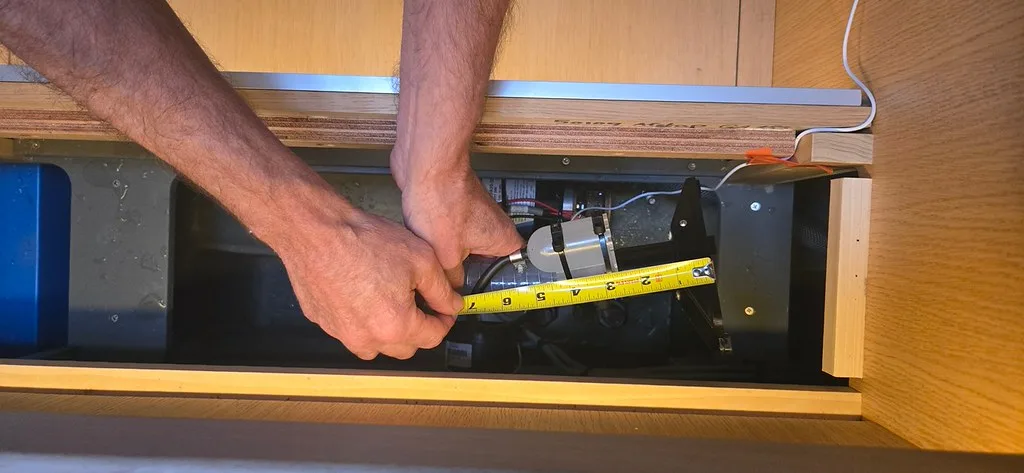
Image source: Openverse / MUSTAD MARINE (PDM 1.0)
battery vs. water-powered: choosing the right backup type
Battery-powered backups win on ease of installation. You connect them to your existing backup system and they’re ready to go. But runtime depends entirely on your battery bank.
A fully charged 12-volt deep-cycle battery can run a typical backup pump for 4 to 8 hours, assuming moderate water inflow.
Water-powered backups draw their power straight from your municipal water supply. They don’t need batteries at all, so they can keep running as long as water pressure holds, which often lasts days after a power outage. They also tend to move more water than battery models, making them a better match for high-risk basements.
But they do have a critical weakness. They require a separate dedicated water line, which means more complex installation and potential code restrictions. Some municipalities limit or prohibit their use due to pressure concerns.
If you’re on a well, they may not work at all.
common sizing mistakes that cause failures
One of the most frequent errors is oversizing the backup pump. Install a 1/2 HP unit in a small basin, and you’ll deal with frequent cycling, premature wear on the float switch, and noise complaints from neighbors who hear the pump kicking on every few minutes. The sweet spot is matching GPH capacity to your actual inflow rate, not maxing out the horsepower.
Undersizing causes even bigger problems. If your backup pump can’t keep up with your basement’s water load, the pit overflows before the storm even passes. Calculate your worst-case scenario, then add that safety margin we talked about.
Another common issue is neglecting discharge compatibility. A backup pump needs its own discharge line, separate from the primary. If both pumps share a pipe without a proper check valve, the primary can backflow and prevent the backup from engaging at all.
Install a dedicated discharge line with its own check valve, and test it regularly.
backup sump pump sizing faqs
does my backup pump need to match my primary pump exactly?
No. Backup pumps operate in short bursts rather than continuous duty cycles. They need enough capacity to handle your peak inflow rate, but they don't have to mirror your primary pump's specifications exactly.
how do i measure my sump pit for the right pump size?
Measure the diameter at the top opening and the depth from the floor to the overflow point. Ensure your backup pump has at least 6 inches of clearance on all sides to prevent clogging and allow proper water circulation around the intake.
what happens if my backup pump is too powerful for my pit?
An oversized pump will cause rapid cycling, where the pump turns on and off frequently. This can burn out the motor prematurely and may cause the float switch to fail due to excessive water movement in a small basin.
can a water-powered backup handle as much flow as a battery-powered one?
Water-powered backups typically move more water volume since they're powered by your home's water pressure. However, their flow rate depends on your incoming water pressure, so homes with low municipal pressure or wells may see reduced performance.